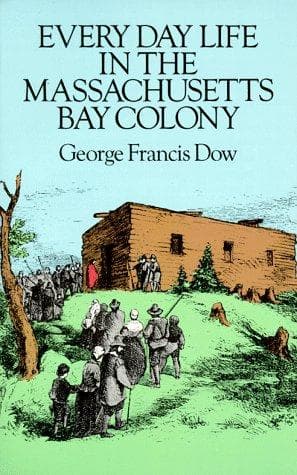
Every Day Life in the Massachusetts Bay ColonyDow, George Francis
History
Every Day Life in the Massachusetts Bay Colony
Dow, George Francis
Massachusetts -- Social life and customs -- To 1775
These small emigrant ships of the seventeenth century, besides men,
women and children, brought over much livestock housed in temporary
pens and shelters built amidships. The long boat or pinnace was also
carried on board, all of which left little room for movement about
the deck. But these three hundred tons ships were traveling palaces
when compared with some of the smaller craft that boldly ventured
across the Atlantic. Barks, ketches, pinks and other small vessels
of less than fifty tons burden were common. In 1635, a "small
Norsey bark" of twenty-five tons reached Boston. She was bound for
Connecticut, but a stormy voyage had forced her to seek safety in
Boston harbor. This vessel, little over thirty feet in length,
brought over fourteen passengers, including two women, with their
household goods.
CHAPTER II
THEIR EARLY SHELTERS AND LATER DWELLINGS
There is a widespread misconception that the colonists on reaching
Massachusetts proceeded immediately to build log houses in which
to live. Historians have described these log houses as chinked
with moss and clay and as having earth floors, precisely the type
of house built on the frontier and in the logging camps at a much
later period. A well-known picture of Leyden Street, at Plymouth,
shows a double row of log houses reaching up the hillside, which
the Pilgrims are supposed to have constructed. In point of fact, no
contemporary evidence has been found that supports the present-day
theory. The early accounts of what took place in the days following
the settlement along the coast are full of interesting details
relating to day-by-day happenings but nowhere do we find allusion
to a log house such as modern historians assume existed at that
time. This unique form of construction, however, had been used in
Scandinavia since the Middle Ages and also in parts of Germany, but
never did it appear in England. It also is well established that the
North American Indians knew nothing of this method of construction,
even the Iroquois tribe who built a "long house," so-called.
The Swedes and Finns who settled in Delaware in 1638 introduced the
log house built of logs with notched ends, with which they were
familiar in their homeland. What more natural? Jasper Dankers and
Peter Sluyter, Dutch travelers, made a tour of the American colonies
in 1679-1680, and while passing through New Jersey, describe the
house of Jacob Hendricks, near the town of Burlington, as follows:
Public-domain text, read in full here on John Shaqi.
Reviews
Reviews
No reviews yet
Be the first to share your thoughts on this work.
Join the Discussion
Join the discussion
Sign in to leave a comment or review.
Sign InorCreate an account