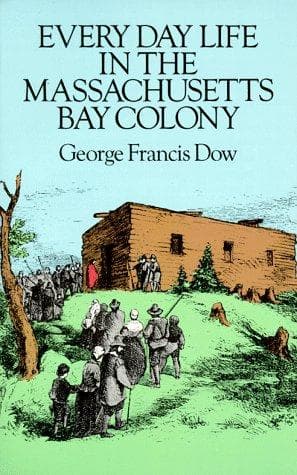
Every Day Life in the Massachusetts Bay ColonyDow, George Francis
History
Every Day Life in the Massachusetts Bay Colony
Dow, George Francis
Massachusetts -- Social life and customs -- To 1775
"The house, although not much larger than where we were the last
night, was somewhat better and tighter, being made according to
the Swedish mode, and as they usually build their houses here,
which are block-houses, being nothing less than entire trees, split
through the middle, or squared out of the rough, and placed in the
form of a square, upon each other, as high as they wish to have the
house; the ends of these timbers are let into each other, about a
foot from the ends, half of one into half of the other, the whole
structure is thus made without a nail or a spike. The ceiling
and roof do not exhibit much finer work, except amongst the most
careful people, who have the ceiling planked and a glass window.
The doors are wide enough, but very low, so that you have to stoop
in entering. These houses are quite tight and warm: but the chimney
is placed in a corner. My comrade and myself had some deer skins,
spread upon the floor to lie on, and we were, therefore, quite well
off and could get some rest."[10]
[10] _Memoirs of the Long Island Historical Society_, Vol. I.
These travelers also spent a night at a Quaker's house near where a
gristmill had been erected on a creek above the falls at what is now
Trenton.
"Here we had to lodge: and although we were too tired to eat, we had
to remain sitting upright the whole night, not being able to find
room enough to lie upon the ground. We had a fire, however, but the
dwellings are so wretchedly constructed, that if you are not close
to the fire, as almost to burn yourself, you cannot keep warm, for
the wind blows through them everywhere. Most of the English and many
others, have their houses made of nothing but clapboards, as they
call them there, in this manner: they first make a wooden frame, the
same as they do in Westphalia, but not so strong, they then split
the boards of clapboard, so that they are like cooper's pipe-staves,
except they are not bent. These are made very thin, with a large
knife, so that the thickest edge is about a little finger thick, and
the other is made sharp, like the edge of a knife. They are about
five or six feet long, and are nailed on the outside of the frame,
with the ends lapped over each other. They are not usually laid so
close together, as to prevent you from sticking a finger between
them, in consequence either of their not being well joined, or the
boards being crooked. When it is cold and windy, the best people
plaster them with clay. Such are most all the English houses in the
country."[11]
[11] _Memoirs of the Long Island Historical Society_, Vol. I.
Public-domain text, read in full here on John Shaqi.
Reviews
Reviews
No reviews yet
Be the first to share your thoughts on this work.
Join the Discussion
Join the discussion
Sign in to leave a comment or review.
Sign InorCreate an account