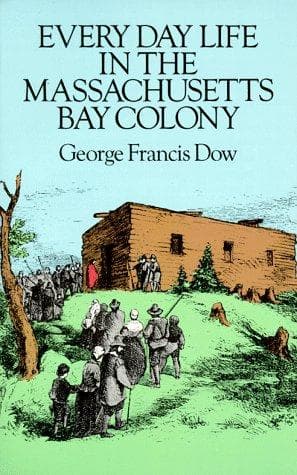
Every Day Life in the Massachusetts Bay ColonyDow, George Francis
History
Every Day Life in the Massachusetts Bay Colony
Dow, George Francis
Massachusetts -- Social life and customs -- To 1775
Alonzo Lewis, the historian of Lynn, writing a century ago, states
that some of the first settlers in that town made shelters for
themselves and families by digging caves into the hillsides. On
the bank of the Connecticut River above Hartford, is the Loomis
Institute, on the grounds of which is the site where the men from
Dorchester, Mass., in 1635, constructed their first dwellings, which
were dug into the river bank. The bank itself composed three walls
of the shelter and the front was a framing of boards with a door and
a window. The roof was thatched with river sedge. The last of these
long abandoned dugouts was filled in as recently as 1926.
At Concord, Mass., the early settlers dug cellars in the earth which
they spanned with wooden spars and then covered with turf. A more
detailed description of such shelters is found in a report made in
1650, by the Secretary of the Province of New Netherlands:
"Those in New Netherlands and especially in New England who have no
means to build farmhouses at first, according to their wishes, dig
a square pit in the ground, cellar fashion, 6 or 7 feet deep, as
long and as broad as they think proper, case the earth inside with
wood all round the wall, and line the wood with bark of trees or
something else to prevent the caving in of the earth, floor this
cellar with plank and wainscott it overhead for a ceiling, raise a
roof of spars clear up and cover the spars with the bark or green
sods, so that they can live dry and warm in these houses with their
entire families for two, three or four years, it being understood
that partitions are run through those cellars which are adapted
to the size of the family. The wealthy and principal men of New
England, in the beginning of the Colonies, commenced their first
dwelling houses in this fashion."[13]
[13] _Documentary History of New York_ (_1850_), Vol. I.
The frequent references to the English wigwam seem to indicate
that some such temporary construction was usual among many of the
colonists at the outset. Settlers were living at Salem as early
as 1626 and Endecott, with a considerable immigration, arrived in
1628. Marblehead, just across the harbor, was settled early and yet
when John Goyt came there in 1637, he "first built a wigwam and
lived thar till he got a house."[14] The rude buildings also put
up by planters at Salem must have been looked upon at the time as
temporary structures for they had all disappeared before 1661.[15]
[14] _Essex Co. (Mass.) Quarterly Court Records_, Vol. VI, p. 363.
[15] _Essex County Deeds_, Book V, leaf 107.
When Governor Winthrop arrived at Charlestown in 1630 with the first
great emigration, he found a house or two and several wigwams--rude
shelters patterned after the huts built by the Indians--and until
houses could be erected in Boston many lived in tents and wigwams,
"their meeting-place being abroad under a Tree."
Public-domain text, read in full here on John Shaqi.
Reviews
Reviews
No reviews yet
Be the first to share your thoughts on this work.
Join the Discussion
Join the discussion
Sign in to leave a comment or review.
Sign InorCreate an account