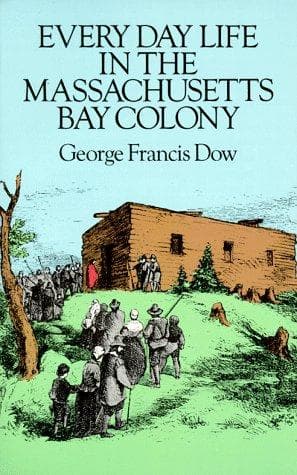
Every Day Life in the Massachusetts Bay ColonyDow, George Francis
History
Every Day Life in the Massachusetts Bay Colony
Dow, George Francis
Massachusetts -- Social life and customs -- To 1775
John Winthrop, in his _Journal_, writes that "the poorer sort of
people (who lay long in tents) were much afflicted with scurvy and
many died, especially at Boston and Charlestown." He also makes
several references to English wigwams. In September, 1630, one
Fitch, of Watertown, had his wigwam burned down with all his goods
and two months later John Firman, also of Watertown, lost his
English wigwam.
Edward Johnson, in his _Wonder-Working Providence_, mentions the
rude shelters of the first settlers. "They kept off the short
showers from their lodgings, but the long rains penetrated through
to their disturbance in the night season, yet in those poor wigwams
they sang Psalms, praise and pray their God till they can provide
them homes which ordinarily was not wont to be with many till the
earth by the Lord's blessing brought forth bread to feed them, their
wives and little ones."
The Rev. Francis Higginson, in his _New-Englands Plantation_,
printed in 1630, describes the wigwams built by the Indians living
at Salem as "verie little and homely, but made with small poles
prick't into the ground and so bended and fastened at the tops and
on the side, they are matted with boughes and covered with sedge and
old mats." It seems likely that when the English built themselves
"English wigwams," they copied the small structures built by the
Indians, especially as mats suitable for covering might be obtained
from the Indians by barter, and old pieces of sailcloth doubtless
might be obtained from the shipping stores. It seems unlikely that
an Englishman living in one of these structures during the winter
season would be content to allow the smoke from his fire to find
its way out through a hole in the roof in the Indian fashion. It
is more likely that a fireplace, built of stones or bricks, would
be constructed at one end of an "English wigwam." A door in hewed
frame, with wooden hinges, probably was installed as a suitable
substitute for the Indian mat lifted upon entering. The floors in
these English wigwams undoubtedly would be covered with rushes or
straw, following the custom in English cottages at that time.
Edward Johnson, the town clerk of Woburn, writing in 1652, relates
of the first settlers that "after they have thus found out a place
of aboad, they burrow themselves in the Earth for their first
shelter under some Hill-side, casting the Earth aloft up on Timber:
they make a smoaky fire against the Earth at the highest side, and
thus these poore servants of Christ provide shelter for themselves,
their Wives and little ones."
Public-domain text, read in full here on John Shaqi.
Reviews
Reviews
No reviews yet
Be the first to share your thoughts on this work.
Join the Discussion
Join the discussion
Sign in to leave a comment or review.
Sign InorCreate an account