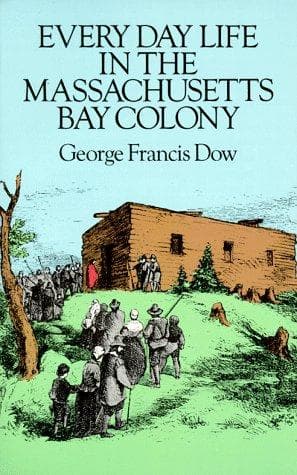
Every Day Life in the Massachusetts Bay ColonyDow, George Francis
History
Every Day Life in the Massachusetts Bay Colony
Dow, George Francis
Massachusetts -- Social life and customs -- To 1775
It is all a matter of common sense reasoning which can be backed
up by an examination of early records and also the furniture
itself. Why pay a considerable value in money to transport, in an
overcrowded ship, utilitarian pieces of furniture, that could be
made in the newly settled colony, by workmen who were going over in
the same ship? Timber could be had here for the cutting and until
sufficient time had elapsed to permit the making of chairs, beds and
other required furniture, one could sit on rudely made stools and
boxes and sleep on pallet beds made up on the floor just as many of
them would be obliged to sleep while on board ship.
Some estimate of the culture of the New England people during the
seventeenth century and of their appreciation of the refinements of
life may be reached with a degree of accuracy through a study of
the carefully itemized inventories of their estates made at time of
death. During that period the Royal Governor from overseas, with
his little court of officials and followers, had not introduced
London fashions and furnishings to the extent that existed in the
eighteenth century. Moreover, the wealth of the colonies had not
grown to the point where the refinements of life were not only
esteemed but demanded by loving spouses and by those who had taken
ship for England or the Continent and there had observed how other
people lived.
Among the early settlements made in the Colony of the Massachusetts
Bay was one at Agawam, now the town of Ipswich. The news had reached
Boston that the French were pushing their settlements westward along
the coast, bringing with them "divers priests and Jesuits," which
so alarmed the Governor and the Assistants that it was decided to
forestall the French and hasten the planting of new towns north
of Boston. The first move was to send the Governor's son John,
with twelve others, to establish themselves at Agawam. There were
no roads and so they sailed along the coast in a shallop and took
possession of the town site in March, 1633. Their families and other
settlers soon followed and the increase of population was such that
in August, 1634, the Court of Assistants decreed that the place be
called Ipswich, after old Ipswich in England, "in acknowledgment of
the great honor and kindness done to our people, who took shipping
there."
Public-domain text, read in full here on John Shaqi.
Reviews
Reviews
No reviews yet
Be the first to share your thoughts on this work.
Join the Discussion
Join the discussion
Sign in to leave a comment or review.
Sign InorCreate an account