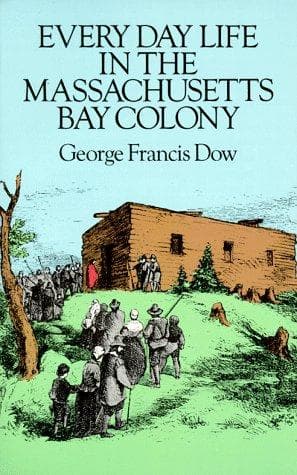
Every Day Life in the Massachusetts Bay ColonyDow, George Francis
History
Every Day Life in the Massachusetts Bay Colony
Dow, George Francis
Massachusetts -- Social life and customs -- To 1775
Three months later, in November, 1634, one John Dillingham arrived
in Ipswich and the selectmen granted him six acres of land on which
to build a house. He was from Leicestershire and with his wife and
daughter had come over in the fleet with Winthrop in 1630, and
remained in Boston until he removed to Ipswich. Life in the frontier
settlement was too severe for him and he died during the next
winter. On July 14, 1636, his widow, Sarah, made her "last will and
testament" being in "perfect memory though my body be weake & sick"
and a few days later she too was dead, leaving her orphaned daughter
to be cared for by Richard Saltonstall and John Appleton, under the
direction of the Quarterly Court. And this was not at all difficult
for John Dillingham had left a "goodly estate," for the times. This
Dillingham home has been selected for analysis because it is one
of the earliest estates in the Colony of which we have exact and
detailed information, a number of documents relating to it having
been preserved among the miscellaneous papers in the Massachusetts
State Archives.[21] Moreover, it shows the furnishings and equipment
of a settler living in a town of only two years growth from the
wilderness.
[21] _Mass. Historical Society Colls._ (5th ser.), Vols. 5-7.
The Dillingham homestead consisted of a house of two rooms and
outbuildings with thirty acres of upland, sixty acres of meadow,
i.e., grass land, and six acres of planting ground near the house,
of which four acres were planted with corn. Apple trees and other
fruits were fenced off in the garden. For livestock there was
a mare, three cows, two steers, two heifers, four calves, and
four pigs. There was an indentured servant, Thomas Downs, to
help cultivate the land and care for the stock, and a maid, Ann
Towle, who not only helped with the housework but also worked in
the fields. "She hath been a faithful servant," wrote Richard
Saltonstall, executor of the estate, "and though she was discharged
by her mistress a little before her time was out, yet it may be
borne by the estate, considering her diligence." Ann had come over
in the ship _Susan and Ellen_, which arrived in April, 1635. Her
passage cost £5.
Public-domain text, read in full here on John Shaqi.
Reviews
Reviews
No reviews yet
Be the first to share your thoughts on this work.
Join the Discussion
Join the discussion
Sign in to leave a comment or review.
Sign InorCreate an account