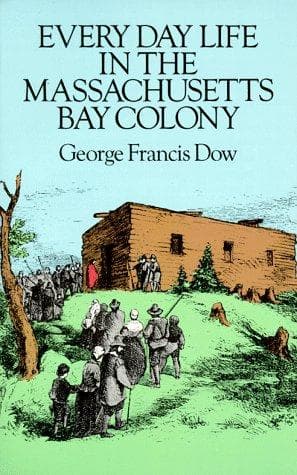
Every Day Life in the Massachusetts Bay Colony — John Shaqi
Every Day Life in the Massachusetts Bay ColonyDow, George Francis
History
Every Day Life in the Massachusetts Bay Colony
Dow, George Francis
Massachusetts -- Social life and customs -- To 1775
The household implements listed were: "1 Iron pot, 1 Kettel, 1
Frying pan, 1 Gridiron, 2 Skellets, 1 Spit, Wooden Platters, Dishes,
Spoons and Trenchers."
Mr. Higginson listed in detail the food supplies required per
person for a year, including a good variety of spices; and also the
clothing for a man, which included a Monmouth cap, a suit of canvas,
a suit of freize, a suit of cloth, four pairs of shoes, three shirts
and three falling bands, a pair of blankets, a coarse rug and seven
ells of canvas with which to make a bed and bolster. The settler
must also bring with him a complete armor, with a long piece, sword,
bandoleer and ammunition, tools for cultivating the soil and for
working wood, and also household implements--a limited equipment,
comparable with the kit packed by the scout or mining prospector of
more recent times.
On looking backward over the span of three centuries, Time lends
an enchantment to these Puritan forefathers of present-day
Massachusetts. Worshiping descendants have placed halos about their
heads and the hardships of life during the early years have been
magnified to the extent that these independent-minded Englishmen
have become types of suffering fortitude--martyrs to the noble cause
of free religion and self-government. That is a long tale, however,
carrying with it many qualifications, and cannot be enlarged upon
here. In what follows, it should always be borne in mind that aside
from the Dutch at New Amsterdam and the small colony of Swedes
on the Delaware, it was English stock that settled the American
colonies and that these men and women brought with them a background
of generations of English life. Their standards of living, manner of
working their trades and natural aptitude for barter and commerce
were all modeled upon English life and customs. It was only
natural that this should be so. The ships crossed the Atlantic at
comparatively frequent intervals and their holds came filled with
all kinds of necessities and luxuries required by English standards
of living--foodstuffs, fabrics and implements which the shops of
London, Plymouth or Bristol could supply and which could not be
produced by the American settlements. To obtain these refinements of
life the colonists required only money or merchandise. Lumber, raw
or manufactured, salted fish, beaver and peltry, plantation-built
vessels and other products of the colonies, could be easily
converted into the comforts of English life for sale in the shops
across the Atlantic.
Public-domain text, read in full here on John Shaqi.
Reviews
Reviews
No reviews yet
Be the first to share your thoughts on this work.
Join the Discussion
Join the discussion
Sign in to leave a comment or review.
Sign InorCreate an account