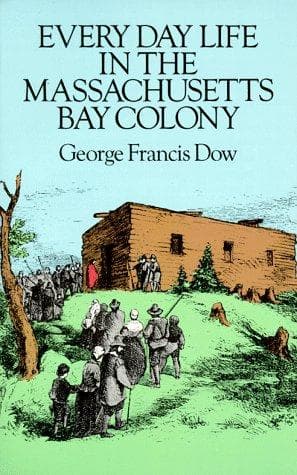
Every Day Life in the Massachusetts Bay ColonyDow, George Francis
History
Every Day Life in the Massachusetts Bay Colony
Dow, George Francis
Massachusetts -- Social life and customs -- To 1775
Googe had been a soldier, for among his personal belongings at death
were a sword and belt, a musket and bandoleers, and also gunpowder.
One cow and four hogs comprised his entire livestock, and five
bushels of wheat, ten bushels of Indian corn, and flax in the bundle
lay in the garret of his house, which was frugally furnished with
a chest, a chair, an old chair, a stool, and a trunk. The family
probably slept on pallet beds made up on the floor, for bedding
is listed but no bedsteads. They had a frying pan, a gridiron, a
skillet, a posnet, an earthen pot, six spoons, and the following
woodenware, viz.: "3 wood trayes & 3 wood boules & 3 wood dishes,
1s. 9d.; one runlitt, 1s.; paieles & tubs, 3s." Two bags valued at
two shillings bring to a close the list of the earthly possessions
of William Googe of Lynn. When the inventory was brought into court
it very properly gave the goods to the widow "for the bringing up of
her three small children." So reads the record.
Doubtless there were many families in the Colony little better
conditioned, judging from the relatively small number of estates
settled through the courts when compared with the deaths and
estimated population.
Googe's house and twelve acres of land were valued at only £8. This
must have been a very simple, thatch-roofed house of not more than
two rooms, comparable with the outlying farmhouse of Jacob Perkins
that was burned in Ipswich in 1668. And thereby hangs a tale. Master
Perkins and his wife had gone to town one summer afternoon leaving
the house in charge of Mehitable Brabrooke, a sixteen-year-old
serving maid. We will let the ancient document in the court files
relate what happened.
"About 2 or 3 aclocke in the afternoone she was taking tobacco in a
pipe and went out of the house with her pipe and gott upon the oven
on the outside & backside of the house (to looke if there were any
hogs in the corne) and she layed her right hand upon the thatch of
the house (to stay herselfe) and with her left hand knocked out her
pipe over her right arme upon the thatch on the eaves of the house
(not thinking there had been any fire in the pipe) and imediately
went downe into the corne feild to drive out the hogs she saw in it,
and as she was going toward the railes of the feild ... she looked
back, and saw a smoke upon her Mistress' house in the place where
she had knocked out her pipe at which shee was much frighted."[24]
[24] _Essex County Quarterly Court Records_, Vol. IV, pp. 56-57.
The wife of a neighbor came running to the assistance of Mehitable
and afterwards testified that when she reached the house she looked
into both fireplaces and saw no appearance of fire, only a few
brands nearly dead under a great kettle hanging in the chimney. She
also looked up into the chamber through the floor boards that lay
very open on the side where the smoke was.
Public-domain text, read in full here on John Shaqi.
Reviews
Reviews
No reviews yet
Be the first to share your thoughts on this work.
Join the Discussion
Join the discussion
Sign in to leave a comment or review.
Sign InorCreate an account