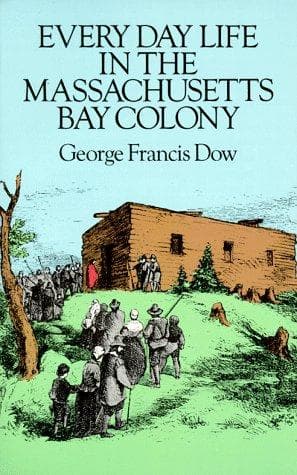
Every Day Life in the Massachusetts Bay ColonyDow, George Francis
History
Every Day Life in the Massachusetts Bay Colony
Dow, George Francis
Massachusetts -- Social life and customs -- To 1775
Could photographs more vividly picture the scene? The thatch-roofed
farmhouse had two rooms on the ground floor and a chimney with
two fireplaces. An oven was built on the backside probably having
an opening inside the kitchen fireplace in the usual manner. The
house was of but one story judging from the low roof that the maid
was able to reach when standing on the oven, and the floor of the
chamber in the loft had wide cracks between the boards so that it
was possible to look through from below and see the under side of
the roof. In similar homes lived many a family in the early days in
comparative comfort.
As for the careless Mehitable, she was brought before the Quarterly
Court on suspicion of wilfully setting the house on fire; a serious
offence, which as late as 1821, was the cause of the execution in
Salem of a sixteen-year-old boy. Among those who deposed at her
trial was a young man who said that as he and she were going into
the meadow, before the fire, to make hay, she told him that her
mistress was angry with her, but she had "fitted her now" for she
had put a great toad into her kettle of milk. As it turned out
the Court ordered Mehitable to be severely whipped and to pay £40
damages to her master Jacob Perkins. It now seems incredible that a
serving maid of 1668 could ever get together so large a sum of money.
The settlers in the New England Colonies, unless persons of wealth
or possessed of large families, during the early years lived
generally in houses having but one room and an entry-way on the
ground floor. Above would be a chamber--sometimes only a garret.
As the family increased in size and became more prosperous another
room would be added to the house on the other side of the entry and
chimney, making the structure a so-called two-room house. Still
later, with the need for more room, a leanto would be built on the
back of the house, thereby supplying three additional rooms on the
ground floor with a kitchen in the middle. The earlier kitchen
would then become a living-room or "sitting room"--in the New
England phrase. This earlier kitchen was usually called "the hall"
during the seventeenth century and in it centered the life of the
family. It was the room where the food was cooked and eaten. There
the family sat and there the indoor work was carried on. A loom
sometimes occupied considerable space near a window and frequently
a bed was made up in a corner, on which the father of the family
slept, and there sometimes also he died.
The principal feature of this common room was its huge fireplace
in which hung pots and kettles suspended by means of pot chains
and trammels from the hardwood trammel-bar or lug-pole that rested
on wooden cross bars and so bisected the wide flue in the chimney.
These large fireplaces in the early days were sometimes called
"chimneys" in the vernacular of the time. They were generally as
wide as eight feet and a ten foot opening is not unknown.
Public-domain text, read in full here on John Shaqi.
Reviews
Reviews
No reviews yet
Be the first to share your thoughts on this work.
Join the Discussion
Join the discussion
Sign in to leave a comment or review.
Sign InorCreate an account