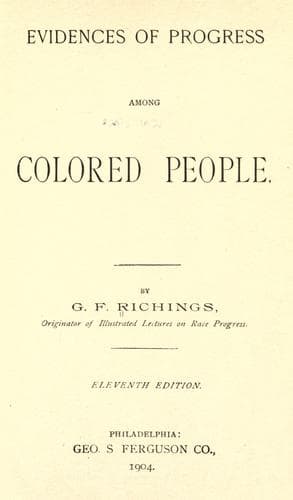
Evidences of Progress Among Colored PeopleRichings, G. F.
History
Evidences of Progress Among Colored People
Richings, G. F.
African Americans
In connection with the Institute there is an industrial department open
to adults on three evenings of the week, Monday, Wednesday and Friday.
Men who are otherwise employed through the day can come here to learn
bricklaying, carpentry, painting, shoemaking, tailoring, plastering
and shorthand and typewriting. This part of the school is under the
supervision of George Astley, an instructor in the Manual Training
School at Seventeenth and Wood streets. For women, three afternoons in
the week are given; there are lessons in dressmaking, millinery and
cooking, under the following instructors: Ida A. Burrell, instructor in
dressmaking; M. Anna Earns, instructor in cooking.
There are other schools supported by the Friends, not only in the State
of Pennsylvania, but in other States. Each one of these schools is well
managed and is well supported. I am sorry that I cannot devote more
space to this work, for it is so helpful and so characteristic of the
Quakers.
MRS. FANNY L. JACKSON COPPIN.
[Illustration: MRS. FANNY L. JACKSON COPPIN.]
Mrs. Fanny L. Jackson Coppin was born in Washington, D. C., and was
educated at Oberlin University, Oberlin, Ohio, from which institution
she graduated. In 1865, she came, by invitation, to Philadelphia,
Pa., and accepted a position as teacher in the "Institute for Colored
Youth," where she has taught constantly ever since; for the past
twenty-eight years she has filled the position of principal. Under her
management the Industrial Department was originated and is now an
important part of the work of this splendid school. She is also the
originator of the "Woman's Exchange."
While there are a great many persons in Philadelphia who know and
admire Mrs. Coppin for her great executive ability, few really know
what a remarkable woman she is. And yet but a brief conversation with
her, or a few moments contact and association, suffices to convince any
one that she is not only a woman of marked intellectual power, but one
of a wide and diverse scope of knowledge, both abstruse and applied.
She is a credit to womankind and while her work as a teacher has been
among colored people, few women are better known as educators and few
if any schools have done a better work in the interest of the race,
than the one she is at the head of. I am told that the "Institute for
Colored Youth" was in the first place started as an experiment, because
it was generally believed that the Negro could not master the higher
branches of education. But in that the colored youth has proven quite
as able as the whites and the results have been most satisfactory.
CAMP NELSON ACADEMY.
Camp Nelson Academy is situated in Jessimine Co., Ky., near
Nicholasville, and is midway between Lexington and Danville.
The academy has one good school building and a dormitory 30 × 60, three
stories high.
To the academy lot is added one hundred and fifteen acres of land, as
endowment, thus far.
Public-domain text, read in full here on John Shaqi.
Reviews
Reviews
No reviews yet
Be the first to share your thoughts on this work.
Elsewhere in the archive
Join the Discussion
Join the discussion
Sign in to leave a comment or review.
Sign InorCreate an account