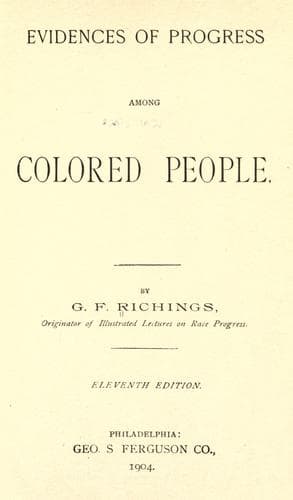
Evidences of Progress Among Colored PeopleRichings, G. F.
History
Evidences of Progress Among Colored People
Richings, G. F.
African Americans
The Richmond Theological Seminary, at Richmond, Va., has a very
remarkable history. It was first commenced in 1868, and started its
work in Lumpkin's Slave Jail, and was first known as Colver Institute.
In 1876 it was incorporated as the Richmond Institute. Subsequently
the trustees and officers of the American Baptist Home Missionary
Society decided to make it a school for ministers only, and in 1886 the
name was changed to the Richmond Theological Seminary. Rev. Charles
Corey, A. M., D. D., was elected president in 1868, and remained in
charge until 1899, when the school went into the Union University. In
speaking of the work, Rev. Corey said: "Of students there have been
in attendance nearly 1,100; total preparing for the ministry, 540;
graduates with diplomas from Richmond Institute, 73; total graduates
with degree of B. D. from Richmond Theological Seminary, 27. Some of
these graduates are now in charge of institutions of learning, others
are professors in seminaries and universities. Six entered the foreign
mission field. The former students of the Richmond Theological Seminary
are to be found from Canada to Texas, and in the lands far beyond the
sea." The school has had among its teachers such men as Prof. J. E.
Jones, D. D., and Prof. D. N. Vassar, D. D. Both of these men are well
educated and represent a high type of true manhood, and they have done
much to advance the race they are identified with. Now Wayland College
and Seminary and Richmond Theological Seminary are united under one
board of trustees. They have at present the Theological Department,
the College Department, the Academic Department and the Preparatory
Department. An industrial plant will, it is hoped, be built. They
already teach the students in a practical way the art of printing
and of managing the steam and electrical plant. This last gives them
quite a knowledge of engineering. The new buildings number eight--a
fine library building, including a chapel and library, a lecture
hall, a dining hall, a dormitory, a power plant, two residences and a
stable. They are constructed of the finest granite, and could not be
duplicated for $300,000. They are situated on a hill about fifty feet
above the valley--a beautiful location in the centre of thirty acres.
The buildings contain every modern improvement--steam heat in all the
rooms and halls, electric lighting and a complete telephone system for
the different buildings and floors, and most approved toilet and bath
arrangements. It is said to be the finest group of buildings in the
whole South.
Public-domain text, read in full here on John Shaqi.
Reviews
Reviews
No reviews yet
Be the first to share your thoughts on this work.
Join the Discussion
Join the discussion
Sign in to leave a comment or review.
Sign InorCreate an account