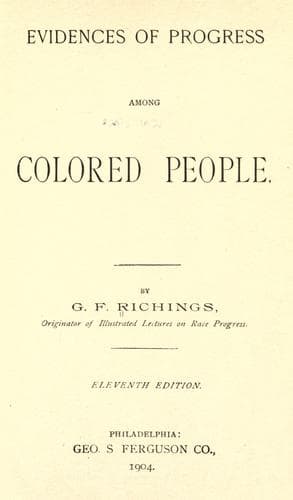
Evidences of Progress Among Colored PeopleRichings, G. F.
History
Evidences of Progress Among Colored People
Richings, G. F.
African Americans
Rev. M. MacVicar, Ph. D., LL. D., is the president of the University,
George Rice Hovey the dean of Wayland Seminary and College, Rev. George
F. Genung, D. D., the dean of the Theological School. The faculty
consists of fifteen teachers of unusual ability, graduates of the best
colleges, some of whom have made a name for themselves already. About
one-half are white. The courses of study are equal to those of the
ordinary Northern schools of similar grade. Virginia Union University
will doubtless be the largest Baptist school operated for colored
people, and it is located in a part of the country where the colored
population is very large, and especially among the Baptists.
ATLANTA BAPTIST SEMINARY.
On the corner of Hunter and Elliott streets, in the city of Atlanta,
Ga., there stands a smoke-begrimed and somewhat dilapidated
brick building bearing the inscription, "American Baptist Home
Mission Society, 1879." Directly in front of the building lies the
shunting-yard of the Southern Railroad. The locality is one of the
nosiest, dustiest and smokiest in the city. It was in this building,
among these unfavorable surroundings, that the work of the Atlanta
Baptist Seminary was carried on from 1879 till 1890.
In the old building no provision was made for dormitories. The
students, most of whom were from the country, were left to find
boarding-houses where they could, and besides living in close and
crowded homes, where the atmosphere was not specially intellectual
and where the opportunities for quiet study were not great, they
were, except for the few hours of school each day, beyond the control
and watchcare of the teachers and exposed to the distractions and
temptations of the city.
For twelve years prior to the year 1879 the Seminary had been located
at Augusta, Ga., and was known as "The Augusta Institute."
Upon the death of Rev. Joseph T. Robert, LL. D., president for
fourteen years, which occurred in 1884, Rev. Samuel Graves, D. D., was
appointed. Dr. Graves was quick to see that the first requisite to the
vigorous growth of the school was a transplanting. Accordingly, he set
to work to secure ground and building. As the result of his efforts the
present campus was secured and the present building erected, and in the
spring of 1890 the Seminary bade farewell to the old building and its
noisy neighbors and took up its abode in its new home.
The main building of the institution was erected in 1889 at a cost
of $27,000. In this beautiful building the visitor will find chapel,
library, eight class-rooms, president's apartments and rooms for six
teachers, dormitory accommodation for about one hundred students,
besides kitchen, dining-room and storerooms, laundry, printing office,
workshop and boiler-room. Rev. George Sales is president.
SHAW UNIVERSITY.
Public-domain text, read in full here on John Shaqi.
Reviews
Reviews
No reviews yet
Be the first to share your thoughts on this work.
Join the Discussion
Join the discussion
Sign in to leave a comment or review.
Sign InorCreate an account