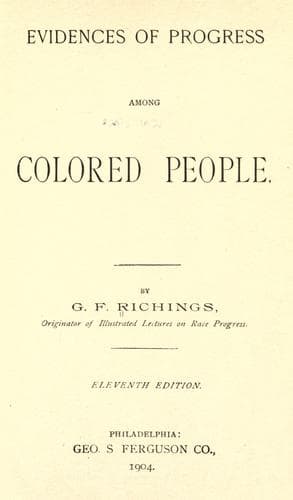
Evidences of Progress Among Colored PeopleRichings, G. F.
History
Evidences of Progress Among Colored People
Richings, G. F.
African Americans
When before this society "came the vision of emancipated millions,
desperately needy, in dire distress and full of forebodings, stretching
forth their unshackled, but empty, unskilled and helpless hands
for friendly aid and guidance," this society at once took them in
and offered them shelter and comfort. The society has accomplished
wonders for the colored people, and I am sure that the colored people
appreciate all that it has done for them.
I shall begin my history of Baptist schools with Spelman Seminary.
SPELMAN SEMINARY.
The history of Spelman Seminary reads like a romance. Beginning
in 1881, in the gloomy basement of the Friendship Baptist Church,
Atlanta, Ga., a church owned by the colored people, without any of the
accessories needed for successful school work, with but two teachers,
Miss S. B. Packard and Miss Harriet E. Giles, and with less than a
dozen pupils, it has grown to be the largest and best equipped school
for the training of colored girls in the United States.
The institution has a magnificent location, and all of the buildings
are specially suited to its needs. Spelman has a large and able faculty
of earnest, devoted teachers, an attendance of pupils numbered by the
hundreds, a constituency of friends and patrons rapidly extending in
numbers and interest, and has made for itself a large place in the
educational forces of the South, and established a reputation of a very
high order.
The question of the education of the colored people as a preparation
for citizenship, just after the war, demanded careful thought and
prompt treatment, and among the noble women who ventured into the
South, fully equipped to do the service they felt was needed, were
Miss S. B. Packard and Miss H. E. Giles. The Southern white people
could not reasonably be expected to throw to the winds all their
cherished traditions and preconceptions simply because they had
acknowledged defeat at the hands of the Northern people. They could
not even be expected to at once admit their former slaves into
political fellowship, recognizing them as equals in all the rights of
citizenship; nor could they be expected to provide schools for the
education of these people. Out of a consideration of these facts,
Northern people, moved by noble and unselfish impulses, made their way
to the South and established these great institutions for the education
of colored people.
Public-domain text, read in full here on John Shaqi.
Reviews
Reviews
No reviews yet
Be the first to share your thoughts on this work.
Join the Discussion
Join the discussion
Sign in to leave a comment or review.
Sign InorCreate an account