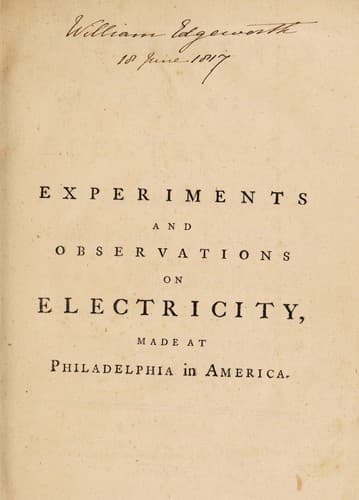
Experiments and Observations on Electricity Made at Philadelphia in America — John Shaqi
Experiments and Observations on Electricity Made at Philadelphia in AmericaFranklin, Benjamin
History
Experiments and Observations on Electricity Made at Philadelphia in America
Franklin, Benjamin
Electricity -- Early works to 1850
These appearances we attempt to account for thus. We suppose as aforesaid,
that electrical fire is a common element, of which every one of the three
persons abovementioned has his equal share, before any operation is begun
with the Tube. _A_, who stands on wax and rubs the tube collects the
electrical fire from himself into the glass; and his communication with the
common stock being cut off by the wax, his body is not again immediately
supply'd. _B_, (who stands on wax likewise) passing his knuckle along near
the tube, receives the fire which was collected by the glass from _A_; and
his communication with the common stock being likewise cut off, he retains
the additional quantity received.--To _C_, standing on the floor, both
appear to be electrised: for he having only the middle quantity of
electrical fire, receives a spark upon approaching _B_, who has an over
quantity; but gives one to _A_, who has an under quantity. If _A_ and _B_
approach to touch each other, the spark is stronger, because the difference
between them is greater; after such touch there is no spark between either
of them and _C_, because the electrical fire in all is reduced to the
original equality. If they touch while electrising, the equality is never
destroy'd, the fire only circulating. Hence have arisen some new terms
among us: we say, _B_, (and bodies like circumstanced) is electrised
_positively_; _A_, _negatively_. Or rather, _B_ is electrised _plus_; _A_,
_minus_. And we daily in our experiments electrise bodies _plus_ or _minus_
as we think proper.--To electrise _plus_ or _minus_, no more needs to be
known than this, that the parts of the tube or sphere that are rubbed, do,
in the instant of the friction attract the electrical fire, and therefore
take it from the thing rubbing: the same parts immediately, as the friction
upon them ceases, are disposed to give the fire they have received, to any
body that has less. Thus you may circulate it, as Mr _Watson_ has shewn;
you may also accumulate or substract it upon or from any body, as you
connect that body with the rubber or with the receiver, the communication
with the common stock being cut off. We think that ingenious gentleman was
deceived, when he imagined (in his _Sequel_) that the electrical fire came
down the wire from the cieling to the gun-barrel, thence to the sphere, and
so electrised the machine and the man turning the wheel, _&c._ We suppose
it was _driven off_, and not brought on thro' that wire; and that the
machine and man, _&c._ were electrised _minus_; _i. e._ had less electrical
fire in them than things in common.
Public-domain text, read in full here on John Shaqi.
Reviews
Reviews
No reviews yet
Be the first to share your thoughts on this work.
Join the Discussion
Join the discussion
Sign in to leave a comment or review.
Sign InorCreate an account