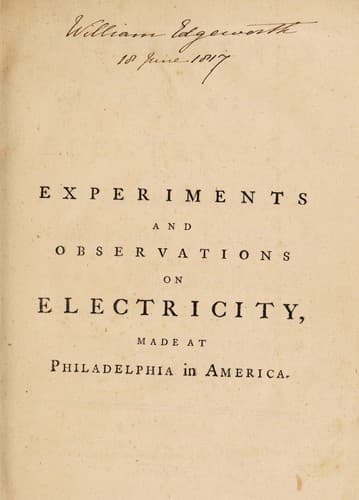
Experiments and Observations on Electricity Made at Philadelphia in AmericaFranklin, Benjamin
History
Experiments and Observations on Electricity Made at Philadelphia in America
Franklin, Benjamin
Electricity -- Early works to 1850
The repellency between the cork-ball and the shot is likewise destroy'd; 1.
By sifting fine sand on it; this does it gradually. 2. By breathing on it.
3. By making a smoke about it from burning wood.[1] 4. By candle light,
even tho' the candle is at a foot distance: these do it suddenly.--The
light of a bright coal from a wood fire; and the light of red-hot iron do
it likewise; but not at so great a distance. Smoke from dry rosin dropt on
hot iron, does not destroy the repellency; but is attracted by both shot
and cork-ball, forming proportionable atmospheres round them, making them
look beautifully, somewhat like some of the figures in _Burnet_'s or
_Whiston_'s theory of the earth.
_N. B._ This experiment should be made in a closet where the air is very
still.
The light of the sun thrown strongly on both cork and shot by a
looking-glass for a long time together, does not impair the repellency in
the least. This difference between fire-light and sun-light, is another
thing that seems new and extraordinary to us.
We had for some time been of opinion, that the electrical fire was not
created by friction, but collected, being really an element diffus'd among,
and attracted by other matter, particularly by water and metals. We had
even discovered and demonstrated its afflux to the electrical sphere, as
well as its efflux, by means of little light windmill wheels made of stiff
paper vanes, fixed obliquely and turning freely on fine wire axes. Also by
little wheels of the same matter, but formed like water wheels. Of the
disposition and application of which wheels, and the various phænomena
resulting, I could, if I had time, fill you a sheet. The impossibility of
electrising one's self (tho' standing on wax) by rubbing the tube and
drawing the fire from it; and the manner of doing it by passing the tube
near a person or thing standing on the floor, &c. had also occurred to us
some months before Mr _Watson_'s ingenious _Sequel_ came to hand, and these
were some of the new things I intended to have communicated to you.--But
now I need only mention some particulars not hinted in that piece, with our
reasonings thereupon; though perhaps the latter might well enough be
spared.
1. A person standing on wax, and rubbing the tube, and another person on
wax drawing the fire; they will both of them, (provided they do not stand
so as to touch one another) appear to be electrised, to a person standing
on the floor; that is, he will perceive a spark on approaching each of them
with his knuckle.
2. But if the persons on wax touch one another during the exciting of the
tube, neither of them will appear to be electrised.
3. If they touch one another after exciting the tube, and drawing the fire
as aforesaid, there will be a stronger spark between them, than was between
either of them and the person on the floor.
4. After such strong spark, neither of them discover any electricity.
Public-domain text, read in full here on John Shaqi.
Reviews
Reviews
No reviews yet
Be the first to share your thoughts on this work.
Join the Discussion
Join the discussion
Sign in to leave a comment or review.
Sign InorCreate an account