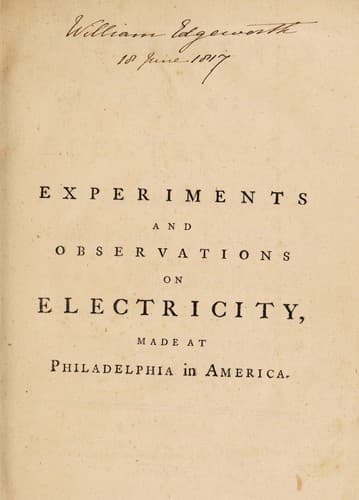
Experiments and Observations on Electricity Made at Philadelphia in America — John Shaqi
Experiments and Observations on Electricity Made at Philadelphia in AmericaFranklin, Benjamin
History
Experiments and Observations on Electricity Made at Philadelphia in America
Franklin, Benjamin
Electricity -- Early works to 1850
7. Place two phials equally charged on a table at five or six inches
distance. Let a cork-ball, suspended by a silk thread, hang between them.
If the phials were both charged through their hooks, the cork, when it has
been attracted and repell'd by the one, will not be attracted, but equally
repelled by the other. But if the phials were charged, the one through the
hook, and the other[3] through the coating, the ball, when it is repelled
from one hook, will be as strongly attracted by the other, and play
vigorously between them, 'till both phials are nearly discharged.
8. When we use the terms of _charging_ and _discharging_ the phial, 'tis in
compliance with custom, and for want of others more suitable. Since we are
of opinion, that there is really no more electrical fire in the phial after
what is called its _charging_, than before, nor less after its
_discharging_; excepting only the small spark that might be given to, and
taken from, the non-electric matter, if separated from the bottle, which
spark may not be equal to a five hundredth part of what is called the
explosion.
For if, on the explosion, the electrical fire came out of the bottle by one
part, and did not enter in again by another; then, if a man standing on
wax, and holding the bottle in one hand, takes the spark by touching the
wire hook with the other, the bottle being thereby _discharged_, the man
would be _charged_; or whatever fire was lost by one, would be found in the
other, since there is no way for its escape: But the contrary is true.
9. Besides the phial will not suffer what is called a _charging_, unless as
much fire can go out of it one way, as is thrown in by another. A phial
cannot be charged standing on wax or glass, or hanging on the prime
conductor, unless a communication be form'd between its coating and the
floor.
10. But suspend two or more phials on the prime conductor, one hanging to
the tail of the other; and a wire from the last to the floor, an equal
number of turns of the wheel shall charge them all equally, and every one
as much as one alone would have been. What is driven out at the tail of the
first, serving to charge the second; what is driven out of the second
charging the third; and so on. By this means a great number of bottles
might be charged with the same labour, and equally high, with one alone,
were it not that every bottle receives new fire, and loses its old with
some reluctance, or rather gives some small resistance to the charging,
which in a number of bottles becomes more equal to the charging power, and
so repels the fire back again on the globe, sooner than a single bottle
would do.
Public-domain text, read in full here on John Shaqi.
Reviews
Reviews
No reviews yet
Be the first to share your thoughts on this work.
Join the Discussion
Join the discussion
Sign in to leave a comment or review.
Sign InorCreate an account