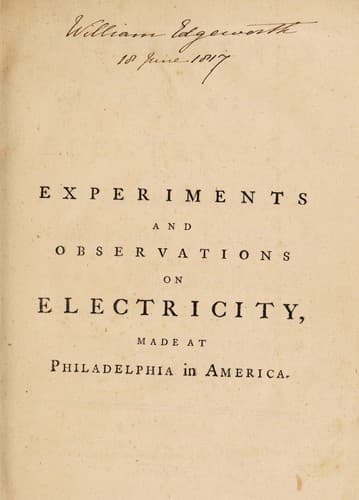
Experiments and Observations on Electricity Made at Philadelphia in AmericaFranklin, Benjamin
History
Experiments and Observations on Electricity Made at Philadelphia in America
Franklin, Benjamin
Electricity -- Early works to 1850
11. When a bottle is charged in the common way, its _inside_ and _outside_
surfaces stand ready, the one to give fire by the hook, the other to
receive it by the coating; the one is full, and ready to throw out, the
other empty and extremely hungry; yet as the first will not _give out_,
unless the other can at the same instant _receive in_; so neither will the
latter receive in, unless the first can at the same instant give out. When
both can be done at once, 'tis done with inconceivable quickness and
violence.
12. So a strait spring (tho' the comparison does not agree in every
particular) when forcibly bent, must, to restore itself, contract that side
which in the bending was extended, and extend that which was contracted; if
either of these two operations be hindered, the other cannot be done. But
the spring is not said to be _charg'd_ with elasticity when bent, and
discharg'd when unbent; its quantity of elasticity is always the same.
13. Glass, in like manner, has, within its substance, always the same
quantity of electrical fire, and that a very great quantity in proportion
to the mass of glass, as shall be shewn hereafter.
14. This quantity, proportioned to the glass, it strongly and obstinately
retains, and will have neither more nor less, though it will suffer a
change to be made in its parts and situation; _i. e._ we may take away part
of it from one of the sides, provided we throw an equal quantity into the
other.
15. Yet when the situation of the electrical fire is thus altered in the
glass; when some has been taken from one side, and some added to the other,
it will not be at rest or in its natural state, till 'tis restored to its
original equality.--And this restitution cannot be made through the
substance of the glass, but must be done by a non-electric communication
formed without, from surface to surface.
16. Thus, the whole force of the bottle, and power of giving a shock, is in
the GLASS ITSELF; the non-electrics in contact with the two surfaces,
serving only to _give_ and _receive_ to and from the several parts of the
glass; that is, to give on one side, and take away from the other.
Public-domain text, read in full here on John Shaqi.
Reviews
Reviews
No reviews yet
Be the first to share your thoughts on this work.
Join the Discussion
Join the discussion
Sign in to leave a comment or review.
Sign InorCreate an account