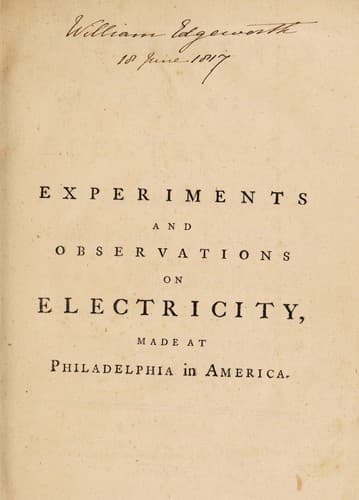
Experiments and Observations on Electricity Made at Philadelphia in AmericaFranklin, Benjamin
History
Experiments and Observations on Electricity Made at Philadelphia in America
Franklin, Benjamin
Electricity -- Early works to 1850
22. But this wheel, like those driven by wind, water, or weights, moves by
a foreign force, to wit, that of the bottles. The self-moving wheel, though
constructed on the same principles, appears more surprising. 'Tis made of a
thin round plate of window-glass, seventeen inches diameter, well gilt on
both sides, all but two inches next the edge. Two small hemispheres of wood
are then fixed with cement to the middle of the upper and under sides,
centrally opposite, and in each of them a thick strong wire eight or ten
inches long, which together make the axis of the wheel. It turns
horizontally on a point at the lower end of its Axis, which rests on a bit
of brass cemented within a glass salt-celler. The upper end of its axis
passes thro' a hole in a thin brass plate cemented to a long strong piece
of glass, which keeps it six or eight inches distant from any non-electric,
and has a small ball of wax or metal on its top to keep in the fire. In a
circle on the table which supports the wheel, are fixed twelve small
pillars of glass, at about four inches distance, with a thimble on the top
of each. On the edge of the wheel is a small leaden bullet communicating by
a wire with the gilding of the _upper_ surface of the wheel; and about six
inches from it is another bullet communicating in like manner with the
_under_ surface. When the wheel is to be charged by the upper surface, a
communication must be made from the under surface to the table. When it is
well charg'd it begins to move; the bullet nearest to a pillar moves
towards the thimble on that pillar, and passing by electrifies it and then
pushes itself from it; the succeeding bullet, which communicates with the
other surface of the glass, more strongly attracts that thimble on account
of its being before electrified by the other bullet; and thus the wheel
encreases its motion till it comes to such a height as that the resistance
of the air regulates it. It will go half an hour, and make one minute with
another twenty turns in a minute, which is six hundred turns in the whole;
the bullet of the upper surface giving in each turn twelve sparks, to the
thimbles, which make seven thousand two hundred sparks; and the bullet of
the under surface receiving as many from the thimbles; those bullets moving
in the time near two thousand five hundred feet.--The thimbles are well
fixed, and in so exact a circle, that the bullets may pass within a very
small distance of each of them.--If instead of two bullets you put eight,
four communicating with the upper surface, and four with the under surface,
placed alternately; which eight, at about six inches distance, compleats
the circumference, the force and swiftness will be greatly increased, the
wheel making fifty turns in a minute; but then it will not continue moving
so long.--These wheels may be applied, perhaps, to the ringing of chimes,
and moving of light-made Orreries.
Public-domain text, read in full here on John Shaqi.
Reviews
Reviews
No reviews yet
Be the first to share your thoughts on this work.
Join the Discussion
Join the discussion
Sign in to leave a comment or review.
Sign InorCreate an account