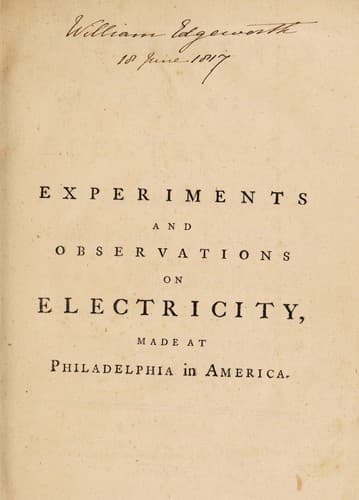
Experiments and Observations on Electricity Made at Philadelphia in AmericaFranklin, Benjamin
History
Experiments and Observations on Electricity Made at Philadelphia in America
Franklin, Benjamin
Electricity -- Early works to 1850
23. A small wire bent circularly with a loop at each end; let one end rest
against the under surface of the wheel, and bring the other end near the
upper surface, it will give a terrible crack, and the force will be
discharged.
24. Every spark in that manner drawn from the surface of the wheel, makes a
round hole in the gilding, tearing off a part of it in coming out; which
shews that the fire is not accumulated on the gilding, but is in the glass
itself.
25. The gilding being varnish'd over with turpentine varnish, the varnish
tho' dry and hard, is burnt by the spark drawn thro' it, and gives a strong
smell and visible smoke. And when the spark is drawn through paper, all
round the hole made by it, the paper will be blacked by the smoke, which
sometimes penetrates several of the leaves. Part of the gilding torn off,
is also found forcibly driven into the hole made in the paper by the
stroke.
26. 'Tis amazing to observe in how small a portion of glass a great
electrical force may lie. A thin glass bubble, about an inch diameter,
weighing only six grains, being half-filled with water, partly gilt on the
outside, and furnish'd with a wire hook, gives, when electrified, as great
a shock as a man can well bear. As the glass is thickest near the orifice,
I suppose the lower half, which being gilt was electrified, and gave the
shock, did not exceed two grains; for it appeared, when broke, much thinner
than the upper half.--If one of these thin bottles be electrified by the
coating, and the spark taken out thro' the gilding, it will break the glass
inwards at the same time that it breaks the gilding outwards.
27. And allowing (for the reasons before given, § 8, 9, 10,) that there is
no more electrical fire in a bottle after charging, than before, how great
must be the quantity in this small portion of glass! It seems as if it were
of its very substance and essence. Perhaps if that due quantity of
electrical fire so obstinately retained by glass, could be separated from
it, it would no longer be glass; it might lose its transparency, or its
brittleness, or its elasticity.--Experiments may possibly be invented
hereafter, to discover this.
Public-domain text, read in full here on John Shaqi.
Reviews
Reviews
No reviews yet
Be the first to share your thoughts on this work.
Join the Discussion
Join the discussion
Sign in to leave a comment or review.
Sign InorCreate an account