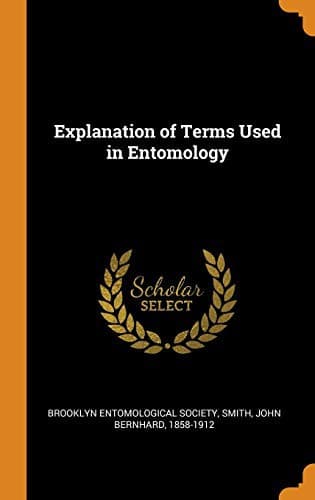
Explanation of Terms Used in Entomology — John Shaqi
Explanation of Terms Used in EntomologySmith, John Bernhard
Science
Explanation of Terms Used in Entomology
Smith, John Bernhard
Insects -- Nomenclature
Chromosome: one of the segments into which the chromoplasmic
filaments of a cell nucleus breaks up just before indirect division.
Chrysalis or -id: applied specifically to the intermedial stage between
larva and adult in butterflies: see pupa.
Chrysargyrus: silvery gilt.
Chyle: the food-mass after it has passed through the guard and is
mixed with the secretions of the salivary glands and caecal structures,
ready to be assimilated.
Chylific ventricle: the true stomach in which the chyle is prepared and
digestion begins.
Cibarian: referring to the mouth parts.
Cicatricose: a surface having scars with elevated margins like those of
small-pox.
Cicatrix: a scar: an elevated, rigid spot.
Cilia: fringes; series of moderate or thin hair arranged in tufts or
single lines; thin scattered hair on a surface or margin.
Ciliate: fringed: set with even, parallel hairs or soft bristles.
Cilium, pl. Cilia: q.v.
Cimicine: an oily fluid of disagreeable odor secreted by certain
Heteroptera and used as a means of defense.
Cimier: the head crest in Pierid chrysalids.
Cinetus: with a colored band:= cingulatus.
Cinereous: ash-colored; gray tinged with blackish [ultra ash gray].
Cinerescent: ashen in color or appearance.
Cingula -um: a colored band or bands.
Circulate -us: having a cingulum or collar: see also cinetus.
Cinnabarine: [vermilion red].
Cinnamomeous: cinnamon brown [burnt sienna].
Cinema: see Thysanura, of which this forms a group including the
bristle-tails, and for which it has been used as an equivalent.
Circinal: spirally rolled like a watch-spring or a butterfly tongue.
Circiter: about, or round-about.
Circular: round like a circle.
Circumgenital glands: small circular glands with an excretory orifice
at tip, disposed in groups about the genital orifice in Diaspinae.
Circumoesophageal commissures: those cords or nerve fibres
connecting the suboesophageal ganglion with the main trunk of
nervous system.
Circumsepted: with a vein all around the wing.
Citrate: antennae with very long, curled lateral branches which may
or may not be ciliated; see plumose.
Cirrose -us: with somewhat dense curled hair.
Cirrus: a curled lock of hair placed on a thin stalk.
Citrine -us: lemon yellow [chrome yellow].
Cladocerous: with branched horns or antennae.
Clasper: a chitinized process, free or attached to the inner sides of
harpes, valves or other lateral pieces, serving to hold the female parts
during copulation: = the harpers of some authors.
Claspette: in genitalia of male culicids, the inner basal lobe of side
piece; q.v.
Clasp-filament: in male genitalia of culicids the articulated appendage
or terminal segment of side-piece or clasp; sometimes bears an
articulated point or apex and then = articulated apex.
Class: a division of the animal kingdom lower than a sub-kingdom
and higher than an order: e.g. the "Class Insecta."
Public-domain text, read in full here on John Shaqi.
Reviews
Reviews
No reviews yet
Be the first to share your thoughts on this work.
Join the Discussion
Join the discussion
Sign in to leave a comment or review.
Sign InorCreate an account