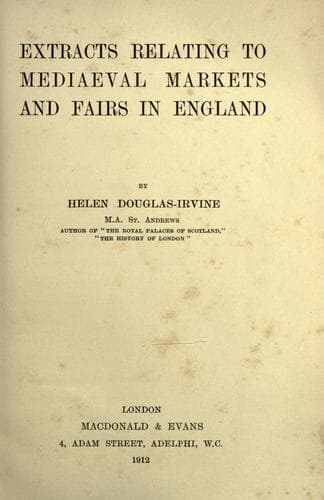
Extracts Relating to Mediaeval Markets and Fairs in England — John Shaqi
Extracts Relating to Mediaeval Markets and Fairs in EnglandDouglas-Irvine, Helen
History
Extracts Relating to Mediaeval Markets and Fairs in England
Douglas-Irvine, Helen
Fairs; Great Britain -- History -- Sources; Markets -- England
1298. To all stewards, bailiffs, and officers of the fair of St.
Botolph and other faithful of Christ to whom the present letters shall
come, Henry le Galeys, mayor of the city of London, as well as the
whole commune send greeting. Know ye that we have made and constituted
our beloved in Christ Elyas Russel, John de Armenters, William de Paris
and William de Mareys, our wardens and attorneys at the present fair of
St. Botolph, to demand and claim and exact all our citizens who are for
any cause arrested or impleaded in any of your courts, and for
executing full justice in all plaints against them according to the law
merchant, ratifying and holding good anything they or any one of them
may do in the premises, and in all other things which they or any one
of them shall deem to affect in any way the liberties of the city and
our citizens. In witness whereof we have set our common seal to these
presents.
London, Sunday the Feast of St. Margaret the Virgin, 26 Edward I.
Sharpe, _Cal. Letter Books of Corporation_, B. 219.
PROFITS.
Besides fines the _tolls_ were the most general source of profit. They
were duties which the tenant of a market might exact on goods brought
into the market and sold there.
1275. _Statute against exorbitant tolls._
Touching them that take outrageous toll, contrary to the common custom
of the realm, in market towns, it is provided that if any do so in the
king's town, which is let in fee-farm, the king shall seize into his
own hand the franchise of the market; and if it be another's town, and
the same be done by the lord of the town, the king shall do in like
manner; and if it be done by a bailiff or any mean officer, without the
commandment of his lord, he shall restore to the plaintiff as much more
for the outrageous taking as he had of him, if he had carried away his
toll, and shall have forty days' imprisonment.
_Statute, 3 Edward I._, cap. 31.
Tolls were not necessarily levied. In later mediæval times it was held
illegal for the holder of a market to exact them unless he could prove
his prescriptive right to do so, or unless, in the case of a market
erected by a charter, such right had been explicitly granted.
1233. Because it has been certified to the king, by an enquiry made in
accordance with his precept, that in the fair of Shalford, which is
held there every year on the feast of the Assumption of Blessed Mary,
it has never been customary to take toll or custom, except at the time
when John of Gatesden was sheriff of Surrey, who of his own will ruled
that toll should there be taken: therefore the sheriff of Surrey is
commanded that he take no custom in that fair nor suffer it to be
taken, and that he cause public proclamation and prohibition to be
made, that in future none take toll on the occasion of that fair.
_Cal. of Close_, 1231-5, 245.
Stallkeepers made payments called _stallage_ for the sites they
occupied to the holder of the market or fair.
Public-domain text, read in full here on John Shaqi.
Reviews
Reviews
No reviews yet
Be the first to share your thoughts on this work.
Join the Discussion
Join the discussion
Sign in to leave a comment or review.
Sign InorCreate an account