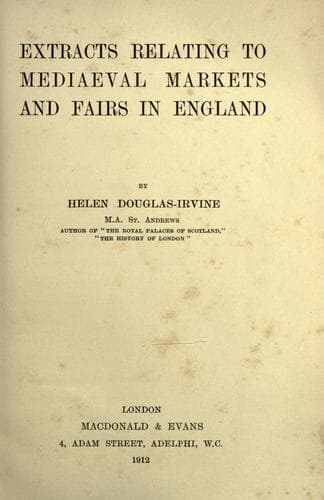
Extracts Relating to Mediaeval Markets and Fairs in EnglandDouglas-Irvine, Helen
History
Extracts Relating to Mediaeval Markets and Fairs in England
Douglas-Irvine, Helen
Fairs; Great Britain -- History -- Sources; Markets -- England
1331. The profits of the bailey of Lincoln, to wit of vacant plots...,
and stallage in the said vacant plots in the times of fairs and
markets.
_Cal. of Close_, 1330-3, 255.
The analogous payment of _piccage_ was for the breaking of the ground
in order to erect stalls.
1550. _Grant of Southwark Fair to the city of London._
... The mayor and commonalty and citizens, and their successors, shall
and may, from henceforth for ever, have, hold, enjoy and use ... tolls,
stallages, piccages.
Birch, _Charters of City of London_, 122.
A duty called _scavage_ or _shewage_ was exacted from strangers who
sold in the fairs.
I have heard also that our townsmen (of Oxford) in their fair, which
they keep at Allhallowtide, do exact of strangers a custom for opening
and shewing their wares, vendible, &c., which is called scavage or
shewage.
Oxford Historical Society, _Charter of Henry II. to the citizens of
Oxford._, II. 2 (from Twyne's MSS. in the Bodleian).
In 1503 it was rendered illegal, except in the case of London, to take
scavage from denizens, otherwise from subjects of the king who were of
alien birth, so long as they sold goods on which due customs had
already been paid.
1503. Be it therefore ordained ... that if any mayor, sheriff, bailiff,
or other officer in any city, borough or town within this realm, take
or levy any custom called Scavage, otherwise called Shewage, of any
merchant denizen, or of any other of the King's subjects denizens, of
or for any manner of merchandise to our Sovereign lord the King before
truly customed, that is brought or conveyed by land or water, to be
uttered and sold in any city, borough, or town in this land, ... that
then every mayor, sheriff, bailiff, or other officer, distraining,
levying, or taking any such Scavage, shall forfeit for every time he so
offendeth £20, the one moiety thereof to our Sovereign lord the King,
and the other moiety thereof to the party in that behalf aggrieved, or
to any other that first sueth in that party by action of debt in any
shire within this realm to be sued.... Provided always that the mayor,
sheriffs, and commonalty of the city of London, and every of them,
shall have and take all such sums of money for the said Scavage, and of
every person denizen, as by our Sovereign lord the King and his
honourable council shall be determined to be the right and title of the
said mayor, sheriffs, and commonalty of the said city of London, or any
of them.
_Statute, 19 Henry VII._, cap. 8.
Certain citizens and burghers, who had the privilege of free trade in
England or throughout the king's dominions, were exempt from paying
tolls or other customs.
_Charter of Henry I. to the citizens of London._
... Let all the men of London be quit and free, and their goods, both
throughout England and in the seaports, of toll and passage[5] and
lastage[6] and all other customs.
Stubbs, _Select Charters_, 108.
Public-domain text, read in full here on John Shaqi.
Reviews
Reviews
No reviews yet
Be the first to share your thoughts on this work.
Join the Discussion
Join the discussion
Sign in to leave a comment or review.
Sign InorCreate an account