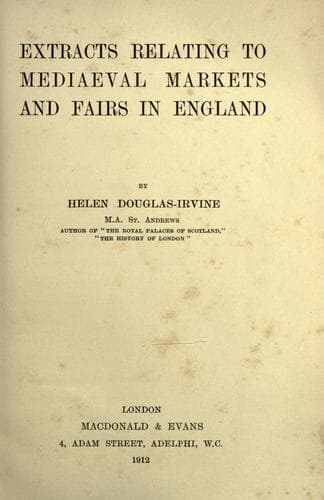
Extracts Relating to Mediaeval Markets and Fairs in EnglandDouglas-Irvine, Helen
History
Extracts Relating to Mediaeval Markets and Fairs in England
Douglas-Irvine, Helen
Fairs; Great Britain -- History -- Sources; Markets -- England
1320. Be it remembered that on the Monday next before the feast of St.
Katherine the Virgin in the 14th year, the pork and beef of John Perer,
John Esmar, and Reynald ate Watre, alleged to be foreign[10] butchers,
were seized because that they against the custom of the city (of
London), had exposed the said meat for sale at Les Stokkes (the Stocks
Market on the site of the Mansion House), after curfew rung at St.
Martin's-le-Grand: whereas it is enacted that no foreign butcher
standing with his meat at the stalls aforesaid shall cut any meat after
None rung at St. Paul's; and that as to all the meat which he has cut
before None rung he is to expose the same for sale up to the hour of
Vespers, and to sell it without keeping any back or carrying any away.
Riley, _Memorials of London_, 142.
[10] See previous footnote.
SUPERVISION OF SALES.
The quality of wares and the prices asked for them were supervised, and
fair dealing was enforced, by officers. Sometimes, as at Oxford, these
were specially appointed for the discharge of their duties. In London
they were the masters or wardens of the crafts, otherwise the
associations of members of one trade. When many of the crafts had
developed into the livery companies the officials of the latter
inherited the inspectorial functions of the wardens.
1393. Ordinance by the mayor and aldermen of London as to markets of
West Cheap and Cornhill.
... That the masters or those assigned thereto of each trade of which
the wares are brought to the said markets shall have power, together
with the beadle of the ward or other officer thereto assigned, to
survey, assay and stop all false and defective wares, in the markets
aforesaid or elsewhere exposed for sale, and to present the same to the
chamberlain to be there adjudged upon as to whether they are
forfeitable or not; and further to arrest to the use of the said
chamber all other things and wares in hostels or other places exposed
for sale against the form.... Of the which forfeitures so by the said
masters, or others thereto assigned, taken and adjudged as forfeited,
the said masters or persons thereto assigned shall have one third part
for their trouble.
Riley, _Memorials of London_, 532.
1556. _Of the clerks of the market of Oxford and of the fixing of
prices._
Public-domain text, read in full here on John Shaqi.
Reviews
Reviews
No reviews yet
Be the first to share your thoughts on this work.
Join the Discussion
Join the discussion
Sign in to leave a comment or review.
Sign InorCreate an account