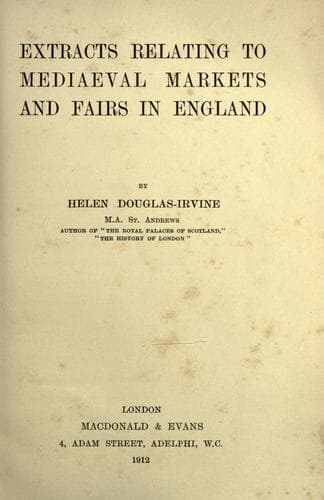
Extracts Relating to Mediaeval Markets and Fairs in EnglandDouglas-Irvine, Helen
History
Extracts Relating to Mediaeval Markets and Fairs in England
Douglas-Irvine, Helen
Fairs; Great Britain -- History -- Sources; Markets -- England
The clerks of the market should be chosen of such as have experience of
the prices which, for necessity or convenience, pertain to food and
clothing, and of such as have knowledge, power and will faithfully and
diligently to fill the office enjoined on them. Especially it behoves
them to see that no fraud is committed as regards the measures and
weights and quality of all foodstuffs and of all things which belong to
clothing, and to observe the statutes and ordinances issued in this
behoof; and since, for the most part, among these commodities, high
prices greatly flourish, the clerk should summon to his aid the
presidents of colleges and such others of the university as he knows to
be fit for the business, and should consult with them as to what course
can be taken to render the prices lower.
Oxford Hist. Soc., _Collectanea_, II. 104.
1468. The assize[11] of a tallowchandler is that he selleth salt,
oatmeal, soap and other divers chaffer, that his weights and measures
be assized[12] and sealed and true beam. For when he buyeth a pound of
tallow for an halfpenny, he shall sell a pound of candle for a penny,
that is a farthing for the wick and the wax and another farthing for
the workmanship. And right as tallow higheth and loweth, so he for to
sell his candle. And if his stuff be not good, or any he lack of his
weight, or any he sell not after the price of tallow, he to be amerced,
the first time twelvepence, the second time twentypence, the third time
fortypence, and to forfeit all that is forfeitable; and he to be judged
according to the form of statutes.
Printed in Strype's edition of Stow's _Cal. of Close_, Book V. 344.
[11] Regulation.
[12] According to regulation.
1327. John de Causton, citizen of London, has shown the king, by
petition before him and his council, that John Dergayn, the late king's
ulnager, in the eighth year of his reign, took five pieces of John's
striped cloth of Gaunt (Ghent) outside his shop in Boston Fair,
asserting that they were not of the assize, and that they were
therefore forfeited to the late king, and delivered to Ralph de Stokes,
then keeper of the king's wardrobe, and that it was afterward found, by
enquiry made by the said king's order before the treasurer and barons
of the Exchequer, that the cloth was of the assize and ought not thus
to be forfeited, and that the cloth was worth 22-1/2 marks; ... and he
has prayed the king to cause that sum to be allowed to him.
_Cal. of Close_, 1327-30, 86.
1366. On the 14th day of October ... John Edmond of Esthamme (East
Ham), cornmonger, of the county of Essex, was brought before John
Lovekyn, mayor, and the aldermen at the Guildhall, for that he had
exposed for sale at Grascherche (Gracechurch) one quarter of oats in a
sack, and had put a bushel of good oats at the mouth of the sack, all
the rest therein being corn of worse quality and of no value, in deceit
of the common people.
Public-domain text, read in full here on John Shaqi.
Reviews
Reviews
No reviews yet
Be the first to share your thoughts on this work.
Join the Discussion
Join the discussion
Sign in to leave a comment or review.
Sign InorCreate an account