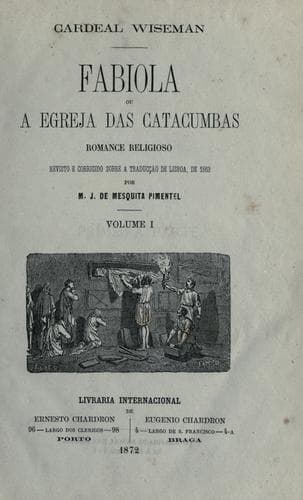
Fabiola; Or, The Church of the CatacombsWiseman, Nicholas Patrick
HistoryHistory
Fabiola; Or, The Church of the Catacombs
Wiseman, Nicholas Patrick
Christian fiction; Church history -- Primitive and early church, ca. 30-600 -- Fiction; Historical fiction
Fabiola handed him a purse abundantly supplied, not only for his
journey, but for an ample recompense. He received it with smiling
readiness, and disappeared by a side alley. There was something in his
manner which made a disagreeable impression; she could not think he was
fit company for her dear old friend. If Chromatius had witnessed the
transaction, he would have seen a likeness to Judas, in that eager
clutching of the purse. Fabiola, however, was not sorry to have
discharged, by a sum of money, once for all, any obligation she might
have contracted by making him her messenger. She therefore drew out her
memorandum to destroy it as useless, when she perceived that the other
side of the vellum was written on; as the transcriber of the book,
which she saw put by, had just commenced its continuation on that sheet.
Only a few sentences, however, had been written, and she proceeded to
read them. Then for the first time she perused the following words from
a book unknown to her:
“I say to you, love your enemies; do good to them that hate you, and
pray for them that persecute and calumniate you: that you may be the
children of your Father who is in heaven, who maketh his sun to rise on
the good and the bad, and raineth upon the just and the unjust.”[68]
We may imagine the perplexity of an Indian peasant who has picked up in
a torrent’s bed a white pellucid pebble, rough and dull outside, but
where chipped emitting sparks of light; unable to decide whether he have
become possessed of a splendid diamond, or of a worthless stone, a thing
to be placed on a royal crown, or trodden under a beggar’s feet. Shall
he put an end to his embarrassment by at once flinging it away, or shall
he take it to a lapidary, ask its value, and perhaps be laughed at to
his face? Such were the alternating feelings of Fabiola on her way home.
“Whose can these sentences be? No Greek or Roman philosopher’s. They are
either very false or very true, either sublime morality or base
degradation. Does any one practise this doctrine, or is it a splendid
paradox? I will trouble myself no more on the subject. Or rather I will
ask Syra about it; it sounds very like one of her beautiful, but
impracticable, theories. No; it is better not. She overpowers me by her
sublime views, so impossible for me, though they seem easy to her. My
mind wants rest. The shortest way is to get rid of the cause of my
perplexity, and forget such harassing words. So here it goes to the
winds, or to puzzle some one else, who may find it on the road-side. Ho!
Phormio, stop the chariot, and pick up that piece of parchment which I
have dropped.”
The outrider obeyed, though he had thought the sheet deliberately flung
out. It was replaced in Fabiola’s bosom: it was like a seal upon her
heart, for that heart was calm and silent till she reached home.
[Illustration: Christ in the midst of His Apostles, from a painting in
the Catacombs.]
CHAPTER XVIII.
TEMPTATION.
Public-domain text, read in full here on John Shaqi.
Reviews
Reviews
No reviews yet
Be the first to share your thoughts on this work.
Elsewhere in the archive
Join the Discussion
Join the discussion
Sign in to leave a comment or review.
Sign InorCreate an account