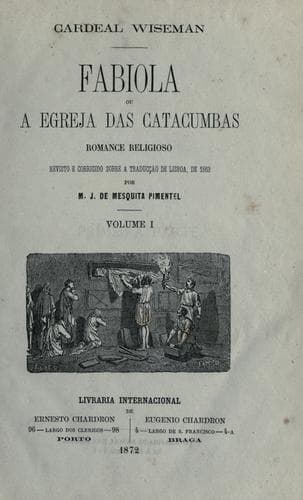
Fabiola; Or, The Church of the CatacombsWiseman, Nicholas Patrick
HistoryHistory
Fabiola; Or, The Church of the Catacombs
Wiseman, Nicholas Patrick
Christian fiction; Church history -- Primitive and early church, ca. 30-600 -- Fiction; Historical fiction
“I had the honor, when very young, as my father had had before me, to be
employed by the noble Fabius in Asia. Ill-health compelled me to leave
his service.”
Several sheets of fine vellum, cut to a size, evidently for
transcription of some book, lay on the table. One of these the good old
man placed before the lady, with ink and a reed, and she wrote a few
affectionate lines to her father. She doubled the paper, tied a thread
round it, attached some wax to this, and impressed her seal, which she
drew from an embroidered bag, upon the wax. Anxious, some time, to
reward the messenger, when she could better know how, she took another
piece of the vellum, and made on it a memorandum of his name and
residence, and carefully put this into her bosom. After partaking of
some slight refreshment, she mounted her car, and bid Chromatius an
affectionate farewell. There was something touchingly paternal in his
look, as though he felt he should never see her again. So she thought;
but it was a very different feeling which softened his heart. Should she
always remain thus? Must he leave her to perish in obstinate ignorance?
Were that generous heart, and that noble intellect, to grovel on in the
slime of bitter paganism, when every feeling and every thought in them
seemed formed of strong yet finest fibres, across which truth might
weave the richest web? It could not be; and yet a thousand motives
restrained him from an avowal, which he felt would, at present, only
repulse her fatally from any nearer approach to the faith. “Farewell, my
child,” he exclaimed, “may you be blessed a hundredfold in ways which
as yet you know not.” He turned away his face, as he dropped her hand,
and hastily withdrew.
Fabiola too was moved by the mystery, as well as the tenderness, of his
words; but was startled, before reaching the gate, to find her chariot
stopped by Torquatus. She was, at that moment, painfully struck by the
contrast between the easy and rather familiar, though respectful, manner
of the youth, and the mild gravity, mixed with cheerfulness, of the old
ex-prefect.
“Pardon this interruption, madam,” he said, “but are you anxious to have
this letter quickly delivered?”
“Certainly, I am _most_ anxious that it should reach my father as
speedily as possible.”
“Then I fear I shall hardly be able to serve you. I can only afford to
travel on foot, or by chance and cheap conveyance, and I shall be some
days upon the road.”
Fabiola, hesitating, said: “Would it be taking too great a liberty, if I
should offer to defray the expenses of a more rapid journey?”
“By no means,” answered Torquatus, rather eagerly, “if I can thereby
better serve your noble house.”
Public-domain text, read in full here on John Shaqi.
Reviews
Reviews
No reviews yet
Be the first to share your thoughts on this work.
Elsewhere in the archive
Join the Discussion
Join the discussion
Sign in to leave a comment or review.
Sign InorCreate an account