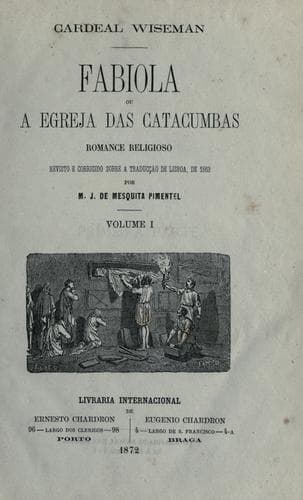
Fabiola; Or, The Church of the CatacombsWiseman, Nicholas Patrick
HistoryHistory
Fabiola; Or, The Church of the Catacombs
Wiseman, Nicholas Patrick
Christian fiction; Church history -- Primitive and early church, ca. 30-600 -- Fiction; Historical fiction
Very early next morning a mule and guide came to the door of
Chromatius’s villa. On it was packed a moderate pair of saddle-bags, the
whole known property of Torquatus. Many friends were up to see him off,
and receive from him the kiss of peace ere he departed. May it not prove
like that of Gethsemani! Some whispered a kind, soft word in his ear,
exhorting him to be faithful to the graces he had received; and he
earnestly, and probably sincerely, promised that he would. Others,
knowing his poverty, put a little present into his hand, and entreated
him to avoid his old haunts and acquaintances. Polycarp, however, the
director of the community, called him aside; and with fervent words and
flowing tears, conjured him to correct the irregularities, slight
perhaps, but threatening, which had appeared in his conduct, repress the
levity which had manifested itself in his bearing, and cultivate more
all Christian virtues. Torquatus, also with tears, promised obedience,
knelt down, kissed the good priest’s hand, and obtained his blessing;
then received from him letters of recommendation for his journey, and a
small sum for its moderate expenses.
At length all was ready; the last farewell was spoken, the last good
wish expressed; and Torquatus, mounted on his mule, with his guide at
its bridle, proceeded slowly along the straight avenue which led to the
gate. Long after every one else had re-entered the house, Chromatius was
standing at the door, looking wistfully, with a moist eye, after him. It
was just such a look as the Prodigal’s father kept fixed on his
departing son.
As the villa was not on the high road, this modest quadrupedal
conveyance had been hired to take him across the country to Fundi (now
Fondi), as the nearest point where he could reach it. There he was to
find what means he could for prosecuting his journey. Fabiola’s purse,
however, had set him very much at ease on that score.
The road by which he travelled was varied in its beauties. Sometimes it
wound along the banks of the Liris, gay with villas and cottages. Then
it plunged into a miniature ravine, in the skirts of the Apennines,
walled in by rocks, matted with myrtle, aloes, and the wild vine, amidst
which white goats shone like spots of snow; while beside the path,
gurgled and wriggled on, a tiny brook, that seemed to have worked itself
into the bright conceit that it was a mountain torrent; so great was the
bustle and noise with which it pushed on, and pretended to foam, and
appeared to congratulate itself loudly on having achieved a waterfall by
leaping down two stones at a time, and plunging into an abyss concealed
by a wide acanthus-leaf. Then the road emerged, to enjoy a wide prospect
of the vast garden of Campania, with the blue bay of Cajeta in the
background, speckled by the white sails of its craft, that looked at
that distance like flocks of bright-plumed waterfowl, basking and
fluttering on a lake.
Public-domain text, read in full here on John Shaqi.
Reviews
Reviews
No reviews yet
Be the first to share your thoughts on this work.
Elsewhere in the archive
Join the Discussion
Join the discussion
Sign in to leave a comment or review.
Sign InorCreate an account