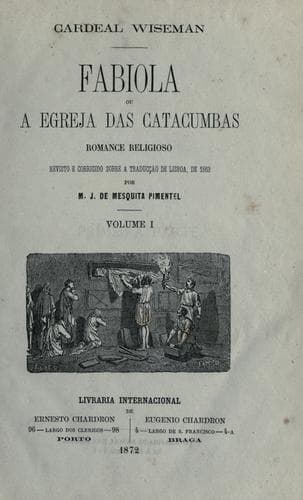
Fabiola; Or, The Church of the CatacombsWiseman, Nicholas Patrick
HistoryHistory
Fabiola; Or, The Church of the Catacombs
Wiseman, Nicholas Patrick
Christian fiction; Church history -- Primitive and early church, ca. 30-600 -- Fiction; Historical fiction
What were the traveller’s thoughts amidst these shifting scenes of a new
act in his life’s drama? did they amuse him? did they delight him? did
they elevate him, or did they depress? His eye scarcely noted them. It
had run on far beyond them, to the shady porticoes and noisy streets of
the
[Illustration: Interior of a Roman Theatre.]
capital. The dusty garden and the artificial fountain, the marble bath
and the painted vault, were more beautiful in his eyes than fresh autumn
vineyards, pure streams, purple ocean, and azure sky. He did not, of
course, for a moment turn his thoughts towards its foul deeds and
impious practices, its luxury, its debauchery, its profaneness, its
dishonesties, its calumnies, its treacheries, its uncleannesses. Oh, no!
what would he, a Christian, have again to do with these? Sometimes, as
his mind became abstracted, it saw, in a dark nook of a hall in the
Thermæ, a table, round which moody but eager gamesters were casting
their knuckle-bone dice; and he felt a quivering creep over him of an
excitement long suppressed; but a pair of mild eyes, like Polycarp’s,
loomed on him from behind the table, and aroused him. Then he caught
himself, in fancy, seated at a maple board, with a ruby gem of Falernian
wine, set in the rim of a golden goblet, and discourse, ungirded by
inebriety, going round with the cup; when the reproving countenance of
Chromatius would seem placed opposite, repelling with a scowl the
approach of either.
[Illustration: Hall in the Baths of Caracalla.]
He was, in fact, returning only to the innocent enjoyments of the
imperial city, to its walks, its music, its paintings, its magnificence,
its beauty. He forgot that all these were but the accessories to a
living and panting mass of human beings, whose passions they enkindled,
whose evil desires they inflamed, whose ambition they fanned, whose
resolutions they melted, and whose minds they enervated. Poor youth! he
thought he could walk through that fire and not be scorched! Poor moth!
he imagined he could fly through that flame, and have his wings
unscathed!
It was in one of his abstracted moods that he journeyed through a narrow
overhung defile, when suddenly he found himself at its opening, with an
inlet of the sea before him, and in it one solitary and motionless
skiff. The sight at once brought to his memory a story of his childhood,
true or false, it mattered not; but he almost fancied its scene was
before him.
Public-domain text, read in full here on John Shaqi.
Reviews
Reviews
No reviews yet
Be the first to share your thoughts on this work.
Elsewhere in the archive
Join the Discussion
Join the discussion
Sign in to leave a comment or review.
Sign InorCreate an account