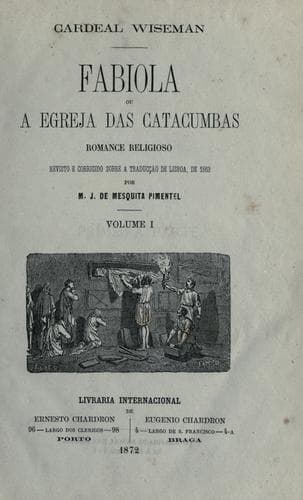
Fabiola; Or, The Church of the CatacombsWiseman, Nicholas Patrick
HistoryHistory
Fabiola; Or, The Church of the Catacombs
Wiseman, Nicholas Patrick
Christian fiction; Church history -- Primitive and early church, ca. 30-600 -- Fiction; Historical fiction
The other son was making a rough design, in which could be distinguished
Jonas devoured by the whale, and Lazarus raised from the dead, both most
conventionally drawn with charcoal on a board; a sketch evidently for a
more permanent painting elsewhere. Further, it was clear that when the
knock came to the door, old Diogenes was busy fitting a new handle to an
old pick-axe. These varied occupations in one family might have
surprised a modern, but they did not at all the youthful visitor; he
well knew that the family belonged to the honorable and religious craft
of the Fossores, or excavators of the Christian cemeteries. Indeed,
Diogenes was the head and director of that confraternity. In conformity
with the assertion of an anonymous writer, contemporary with St. Jerome,
some modern antiquarians have considered the _fossor_ as forming a
lesser ecclesiastical order in the primitive Church, like the _lector_,
or reader. But although this opinion is untenable, it is extremely
probable that the duties of this office were in the hands of persons
appointed and recognized by ecclesiastical authority. The uniform system
pursued in excavating, arranging, and filling up of the numerous
cemeteries round Rome, a system too, so complete from the beginning, as
not to leave positive signs of improvement or change as time went on,
gives us reason to conclude that these wonderful and venerable works
were carried on under one direction, and probably by some body
associated for that purpose. It was not a cemetery or necropolis
company, which made a speculation of burying the dead, but rather a
pious and recognized confraternity which was associated for the purpose.
A series of interesting inscriptions, found in the cemetery of St.
Agnes, proves that this occupation was continued in particular families;
grandfather, father, and sons, having carried it on in the same
place.[73] We can thus easily understand the great skill and uniformity
of practice observable in the catacombs. But the _fossores_ had
evidently a higher office, or even jurisdiction, in that underground
world. Though the Church provided space for the burial of all her
children, it was natural that some should make compensation for their
place of sepulture, if chosen in a favorite spot, such as the vicinity
of a martyr’s tomb. These sextons had the management of such
transactions, which are often recorded in the ancient cemeteries. The
following inscription is preserved in the Capitol:
=EMPTV LOCVM AB ARTEMISIVM VISOMVM HOC EST
ET PRAETIVM DATVM FOSSORI HILARO IDEST
FOL NOOD PRAESENTIA SEVERI FOSS ET LAVRENTI=
That is--
“This is the grave for two bodies, bought by Artimisius; and the
price was given to the Fossor Hilarus,--that is, purses....[74] In
the presence of Severus the Fossor and Laurentius.”
Public-domain text, read in full here on John Shaqi.
Reviews
Reviews
No reviews yet
Be the first to share your thoughts on this work.
Elsewhere in the archive
Join the Discussion
Join the discussion
Sign in to leave a comment or review.
Sign InorCreate an account