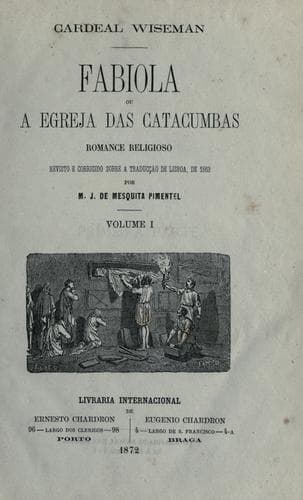
Fabiola; Or, The Church of the CatacombsWiseman, Nicholas Patrick
HistoryHistory
Fabiola; Or, The Church of the Catacombs
Wiseman, Nicholas Patrick
Christian fiction; Church history -- Primitive and early church, ca. 30-600 -- Fiction; Historical fiction
Possibly the last named was the witness on the purchaser’s side, and
Severus on the seller’s. However this may be, we trust we have laid
before our readers all that is known about the profession, as such, of
Diogenes and his sons.
We left Pancratius amused at Majus’s rude attempts in glyptic art; his
next step was to address him.
“Do you always execute these inscriptions yourself?”
“Oh, no,” answered the artist, looking up and smiling. “I do them for
poor people who cannot afford to pay a better hand. This was a good
woman who kept a small shop in the _Vianova_, and you may suppose did
not become rich, especially as she was very honest. And yet a curious
thought struck me as I was carving her epitaph.”
“Let me hear it, Majus.”
“It was, that perhaps some thousand years hence or more, Christians
might read with reverence my scratches on the wall, and hear of poor old
Pollecla and her barley stall with interest, while the inscription of
not a single emperor, who persecuted the Church, would be read or even
known.”
“Well, I can hardly imagine that the superb mausoleums of sovereigns
will fall to utter decay, and yet the memory of a market-wife descend to
distant ages. But what is your reason for thinking thus?”
“Simply because I would sooner commit to the keeping of posterity the
memory of the pious poor than that of the wicked rich. And my rude
record may possibly be read when triumphal arches have been demolished.
It’s dreadfully written though, is it not?”
[Illustration: A gallery in the Cemetery of St. Agnes, on the Nomentan
Way.]
“Never mind that; its simplicity is worth much fine writing. What is
that slab leaning against the wall?”
“Ah, that _is_ a beautiful inscription brought us to put up; you will
see the writer and engraver were different people. It is to go to the
cemetery at the Lady Agnes’s villa, on the Nomentan way. I believe it is
in memory of a most sweet child, whose death is deeply felt by his
virtuous parents.” Pancratius took a light to it, and read as follows:
[Illustration: Inscription of the Cemetery of Saint Agnes.]
“The innocent boy Dionysius lieth here among the saints. Remember
us in your holy prayers, the writer and the engraver.”
“Dear, happy child!” continued Pancratius, when he had perused the
inscription: “add me the reader, to the writer and carver of thine
epitaph, in thy holy prayers.”
“Amen,” answered the pious family.
But Pancratius, attracted by a certain husky sound in Diogenes’s voice,
turned round, and saw the old man vigorously trying to cut off the end
of a little wedge which he had driven into the top of the handle of his
pick-axe, to keep it fast in the iron; but every moment baffled by some
defect in his vision, which he removed by drawing the back of his brawny
hand across his eyes. “What is the matter, my good old friend?” said the
youth kindly. “Why does this epitaph of young Dionysius particularly
affect you?”
Public-domain text, read in full here on John Shaqi.
Reviews
Reviews
No reviews yet
Be the first to share your thoughts on this work.
Elsewhere in the archive
Join the Discussion
Join the discussion
Sign in to leave a comment or review.
Sign InorCreate an account