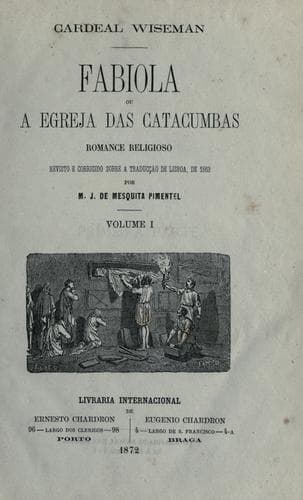
Fabiola; Or, The Church of the CatacombsWiseman, Nicholas Patrick
HistoryHistory
Fabiola; Or, The Church of the Catacombs
Wiseman, Nicholas Patrick
Christian fiction; Church history -- Primitive and early church, ca. 30-600 -- Fiction; Historical fiction
“It does not of itself; but it reminds me of so much that is past, and
suggests so much that may be about to come, that I feel almost faint to
think of either.”
“What are your painful thoughts, Diogenes?”
“Why, do you see, it is all simple enough to take into one’s arms a good
child like Dionysius, wrapped in his cerecloth, fragrant with spices,
and lay him in his grave. His parents may weep, but his passage from
sorrow to joy was easy and sweet. It is a very different thing, and
requires a heart as hardened as mine by practice” (another stroke of the
hand across the eyes) “to gather up hastily the torn flesh and broken
limbs of such another youth, to wrap them hurriedly in their
winding-sheet, then fold them into another sheet full of lime, instead
of balsams, and shove them precipitately into their tomb.[75] How
differently one would wish to treat a martyr’s body!”
[Illustration: An _Arcosolium_.]
“True, Diogenes; but a brave officer prefers the plain soldier’s grave,
on the field of battle, to the carved sarcophagus on the Via Appia. But
are such scenes as you describe common, in times of persecution?”
“By no means uncommon, my good young master. I am sure a pious youth
like you must have visited, on his anniversary, the tomb of Restitutus
in the cemetery of Hermes.”
“Indeed I have, and often have I been almost jealous of his early
martyrdom. Did you bury him?”
“Yes; and his parents had a beautiful tomb made, the _arcosolium_ of his
crypt.[76] My father and I made it of six slabs of marble, hastily
collected, and I engraved the inscription now beside it. I think I
carved better than Majus there,” added the old man, now quite cheerful.
“That is not saying much for yourself, father,” rejoined his son, no
less smiling; “but here is the copy of the inscription which you wrote,”
he added, drawing out a parchment from a number of sheets.
“I remember it perfectly,” said Pancratius, glancing over it, and
reading it as follows, correcting the errors in orthography, but not
those in grammar, as he read:
[Illustration]
“To Ælius Fabius Restitutus, their most pious son, his parents
erected (this tomb). Who lived eighteen years and seven months. In
peace.”
He continued: “What a glorious youth, to have confessed Christ at such
an age!”
“No doubt,” replied the old man; “but I dare say you have always thought
that his body reposes alone in his sepulchre. Any one would think so
from the inscription.”
“Certainly I have always thought so. Is it otherwise?”
Public-domain text, read in full here on John Shaqi.
Reviews
Reviews
No reviews yet
Be the first to share your thoughts on this work.
Elsewhere in the archive
Join the Discussion
Join the discussion
Sign in to leave a comment or review.
Sign InorCreate an account