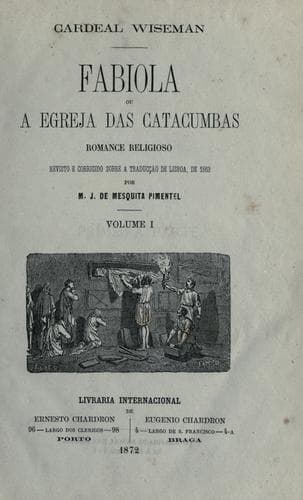
Fabiola; Or, The Church of the CatacombsWiseman, Nicholas Patrick
HistoryHistory
Fabiola; Or, The Church of the Catacombs
Wiseman, Nicholas Patrick
Christian fiction; Church history -- Primitive and early church, ca. 30-600 -- Fiction; Historical fiction
“Yes, noble Pancratius, he has a comrade younger than himself lying in
the same bed. As we were closing the tomb of Restitutus, the body of a
boy not more than twelve or thirteen years old was brought to us. Oh, I
shall never forget the sight! He had been hung over a fire, and his
head, trunk, and limbs nearly to the knees, were burnt to the very bone;
and so disfigured was he that no feature could be recognized. Poor
little fellow, what he must have suffered! But why should I pity him?
Well, we were pressed for time, and we thought the youth of eighteen
would not grudge room for his fellow-soldier of twelve, but would own
him for a younger brother; so we laid him at Ælius Fabius’s feet. But we
had no second phial of blood to put outside, that a second martyr might
be known to lie there; for the fire had dried his blood up in his
veins.”[77]
“What a noble boy! If the first was older, the second was younger than
I. What say you, Diogenes, don’t you think it likely you may have to
perform the same office for me one of these days?”
“Oh, no, I hope not,” said the old digger, with a return of his husky
voice. “Do not, I entreat you, allude to such a possibility. Surely my
own time must come sooner. How the old trees are spared, indeed, and the
young plants cut down!”
“Come, come, my good friend, I won’t afflict you. But I have almost
forgotten to deliver the message I came to bring. It is, that to-morrow
at dawn you must come to my mother’s house, to arrange about preparing
the cemeteries for our coming troubles. Our holy Pope will be there,
with the priests of the titles, the regionary deacons, the notaries,
whose number has been filled up, and you, the head _fossor_, that all
may act in concert.”
“I will not fail, Pancratius,” replied Diogenes.
“And now,” added the youth, “I have a favor to ask you.”
“A favor from me?” asked the old man, surprised.
“Yes; you will have to begin your work immediately, I suppose. Now,
often as I have visited, for devotion, our sacred cemeteries, I have
never studied or examined them; and this I should like to do with you,
who know them so well.”
“Nothing would give me greater pleasure,” answered Diogenes, somewhat
flattered by the compliment, but still more pleased by this love for
what he so much loved. “After I have received my instructions, I shall
go at once to the cemetery of Callistus. Meet me out of the Porta
Capena, half an hour before mid-day, and we will go on together.”
“But I shall not be alone,” continued Pancratius. “Two youths, recently
baptized, desire much to become acquainted with our cemeteries, which
they do not yet much know; and have asked me to initiate them there.”
“Any friends of yours will be always welcome. What are their names, that
we may make no mistake?”
“One is Tiburtius, the son of Chromatius, the late prefect; the other is
a young man named Torquatus.”
Severus started a little, and said: “Are you quite sure about him,
Pancratius?”
Public-domain text, read in full here on John Shaqi.
Reviews
Reviews
No reviews yet
Be the first to share your thoughts on this work.
Elsewhere in the archive
Join the Discussion
Join the discussion
Sign in to leave a comment or review.
Sign InorCreate an account