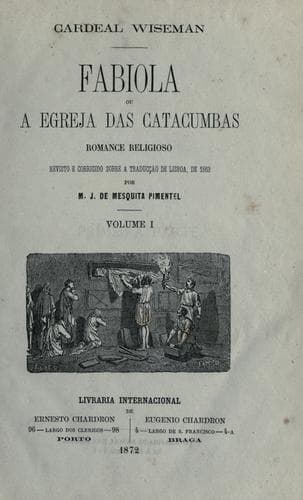
Fabiola; Or, The Church of the CatacombsWiseman, Nicholas Patrick
HistoryHistory
Fabiola; Or, The Church of the Catacombs
Wiseman, Nicholas Patrick
Christian fiction; Church history -- Primitive and early church, ca. 30-600 -- Fiction; Historical fiction
A few days after Fabiola’s return from the country, Sebastian considered
it his duty to wait upon her, to communicate so much of the dialogue
between Corvinus and her black slave, as he could without causing
unnecessary suffering. We have already observed, that of the many noble
youths whom Fabiola had met in her father’s house, none had excited her
admiration and respect except Sebastian. So frank, so generous, so
brave, yet so unboasting; so mild, so kind in act and speech, so
unselfish and so careful of others, blending so completely in one
character nobleness and simplicity, high wisdom and practical sense, he
seemed to her the most finished type of manly virtue, one which would
not easily suffer by time, nor weary by familiarity.
When, therefore, it was announced to her that the officer Sebastian
wished to speak to her alone, in one of the halls below, her heart beat
at the unusual tidings, and conjured up a thousand strange fancies,
about the possible topics of his interview. This agitation was not
diminished, when, after apologizing for his seeming intrusion, he
remarked with a smile, that, well knowing how sufficiently she was
already annoyed by the many candidates for her hand, he felt regret at
the idea that he was going to add another, yet undeclared, to her list.
If this ambiguous preface surprised, and perhaps elated her, she was
soon depressed again, upon being told it was the vulgar and stupid
Corvinus. For her father, even, little as he knew how to discriminate
characters out of business, had seen enough of him at his late banquet
to characterize him to his daughter by those epithets.
Sebastian, fearing rather the physical, than the moral activity of
Afra’s drugs, thought it right to inform her of the compact between the
two dabblers in the black art, the principal efficacy of which, however,
seemed to consist in drawing money from the purse of a reluctant dupe.
He of course said nothing of what related to the Christians in that
dialogue. He put her on her guard, and she promised to prevent the
nightly excursions of her necromancer slave. What Afra had engaged to
do, she did not for a moment believe it was ever her intention to
attempt; neither did she fear arts which she utterly despised. Indeed
Afra’s last soliloquy seemed satisfactorily to prove that she was only
deceiving her victim. But she certainly felt indignant at having been
bargained about by two such vile characters, and having been represented
as a grasping avaricious woman, whose price was gold.
“I feel,” she said at last to Sebastian, “how very kind it is of you, to
come thus to put me on my guard; and I admire the delicacy with which
you have unfolded so disagreeable a matter, and the tenderness with
which you have treated every one concerned.”
“I have only done in this instance,” replied the soldier, “what I should
have done for any human being,--save him, if possible, from pain or
danger.”
Public-domain text, read in full here on John Shaqi.
Reviews
Reviews
No reviews yet
Be the first to share your thoughts on this work.
Elsewhere in the archive
Join the Discussion
Join the discussion
Sign in to leave a comment or review.
Sign InorCreate an account