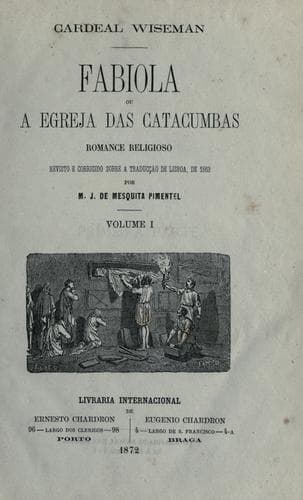
Fabiola; Or, The Church of the CatacombsWiseman, Nicholas Patrick
HistoryHistory
Fabiola; Or, The Church of the Catacombs
Wiseman, Nicholas Patrick
Christian fiction; Church history -- Primitive and early church, ca. 30-600 -- Fiction; Historical fiction
“Your friends, I hope you mean,” said Fabiola, smiling; “otherwise I
fear your whole life would go, in works of unrequited benevolence.”
“And so let it go; it could not be better spent.”
“Surely, you are not in earnest, Sebastian. If you saw one who had ever
hated you, and sought your destruction, threatened with a calamity,
which would make him harmless, would you stretch out your hand to save,
or succor, him?”
“Certainly I would. While God sends His sunshine and His rain equally
upon His enemies, as upon His friends, shall weak man frame another rule
of justice?”
At these words Fabiola wondered; they were so like those of her
mysterious parchment, identical with the moral theories of her slave.
“You have been in the East, I believe, Sebastian,” she asked him, rather
abruptly; “was it there that you learnt these principles? For I have one
near me, who is yet, by her own choice, a servant, a woman of rare moral
perceptions, who has propounded to me the same ideas; and she is an
Asiatic.”
“It is not in any distant country that I learnt them; for here I sucked
them in with my mother’s milk; though, originally, they doubtless came
from the East.”
“They are certainly beautiful in the abstract,” remarked Fabiola; “but
death would overtake us before we could half carry them out, were we to
make them our principles of conduct.”
“And how better could death find us, though not surprise us, than in
thus doing our duty, even if not to its completion?”
“For my part,” resumed the lady, “I am of the old Epicurean poet’s mind.
This world is a banquet, from which I shall be ready to depart when I
have had my fill--_ut conviva satur_[113]--and not till then. I wish to
read life’s book through, and close it calmly, only when I have finished
its last page.”
Sebastian shook his head, smiling, and said, “The last page of this
world’s book comes but in the middle of the volume, wherever ‘death’
may happen to be written. But on the next page begins the illuminated
book of a new life--without a last page.”
“I understand you,” replied Fabiola, good-humoredly; “you are a brave
soldier, and you speak as such. _You_ must be always prepared for death
from a thousand casualties; _we_ seldom see it approach suddenly; it
comes more mercifully, and stealthily, upon the weak. You no doubt are
musing on a more glorious fate, on receiving in front full sheaves of
arrows from the enemy, and falling covered with honor. You look to the
soldier’s funeral pile, with trophies erected over it. To you, after
death, opens its bright page the book of glory.”
Public-domain text, read in full here on John Shaqi.
Reviews
Reviews
No reviews yet
Be the first to share your thoughts on this work.
Elsewhere in the archive
Join the Discussion
Join the discussion
Sign in to leave a comment or review.
Sign InorCreate an account