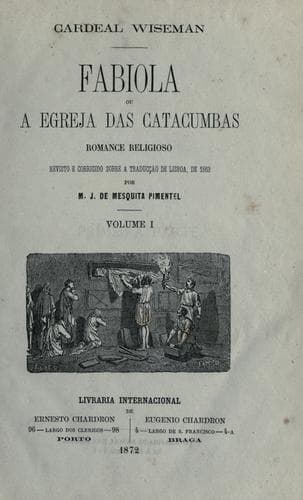
Fabiola; Or, The Church of the CatacombsWiseman, Nicholas Patrick
HistoryHistory
Fabiola; Or, The Church of the Catacombs
Wiseman, Nicholas Patrick
Christian fiction; Church history -- Primitive and early church, ca. 30-600 -- Fiction; Historical fiction
As in every other city, so in Rome, the eucharistic sacrifice was
offered originally in only one place, by the bishop. And even after more
churches were erected, and the faithful met in them, communion was
brought to them from the one altar by the deacons, and distributed by
the priests. It was Pope Evaristus, the fourth successor of St. Peter,
who multiplied the churches of Rome with circumstances peculiarly
interesting.
This Pope, then, did two things. First, he enacted that from
thenceforward no altars should be erected except of stone, and that they
should be consecrated; and secondly, “he distributed the _titles_;” that
is, he divided Rome into parishes, to the churches of which he gave the
name of “title.” The connection of these two acts will be apparent to
any one looking at Genesis xxviii.; where, after Jacob had enjoyed an
angelic vision, while sleeping with a stone for his pillow, we are told
that, “trembling he said, How terrible is this place! _This is no other
than the house of God_, and the gate of heaven. And Jacob arising in the
morning _took the stone_,..... _and set it up for a title, pouring oil
on the top of it_.”[122]
The church or oratory, where the sacred mysteries were celebrated, was
truly, to the Christian, the house of God; and the stone altar, set up
in it, was consecrated by the pouring of oil upon it, as is done to this
day (for the whole law of Evaristus remains in full force); and thus
became a _title_, or monument.[123]
Two interesting facts are elicited from this narrative. One is, that to
that time there was only one church with an altar in Rome; and no doubt
has ever been raised, that this was the church afterwards, and yet,
known by the name of St. Pudentiana. Another is, that the one altar till
then existing was not of stone. It was, in fact, the wooden altar used
by St. Peter, and kept in that church, till transferred by St. Sylvester
to the Lateran basilica, of which it forms the high altar.[124] We
further conclude, that the law was not retrospective, and that the
wooden altar of the Popes was preserved at that church, where it had
been first erected, though from time to time it might be carried, and
used elsewhere.
The church in the Vicus Patricius, therefore, which existed previous to
the creation of _titles_, was not itself a title. It continued to be the
episcopal, or rather the pontifical church of Rome. The pontificate of
St. Pius I., from 142 to 157, forms an interesting period in its
history, for two reasons.
First, that Pope, without altering the character of the church itself,
added to it an oratory which he made a _title_;[125] and having collated
to it his brother Pastor, it was called the _titulus Pastoris_, the
designation, for a long time, of the cardinalate attached to the church.
This shows that the church itself was more than a title.
Public-domain text, read in full here on John Shaqi.
Reviews
Reviews
No reviews yet
Be the first to share your thoughts on this work.
Elsewhere in the archive
Join the Discussion
Join the discussion
Sign in to leave a comment or review.
Sign InorCreate an account