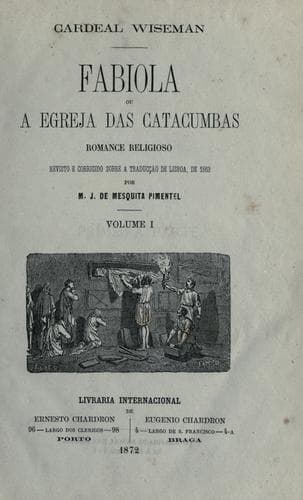
Fabiola; Or, The Church of the CatacombsWiseman, Nicholas Patrick
HistoryHistory
Fabiola; Or, The Church of the Catacombs
Wiseman, Nicholas Patrick
Christian fiction; Church history -- Primitive and early church, ca. 30-600 -- Fiction; Historical fiction
Secondly, in this pontificate came to Rome, for the second time, and
suffered martyrdom, the holy and learned apologist St. Justin. By
comparing his writings with his Acts,[126] we come to some interesting
conclusions respecting Christian worship in times of persecution.
“In what place do the Christians meet?” he is asked by the judge.
“Do you think,” he replies, “that we all meet in one place? It is not
so.” But when interrogated where he lived, and where he held meetings
with his disciples, he answered, “I have lived till now near the house
of a certain Martin, at the bath known as the Timotine. I have come to
Rome for the second time, nor do I know any other place but the one I
have mentioned.” The Timotine or Timothean baths were part of the house
of the Pudens family, and are those at which we have said that Fulvius
and Corvinus met early one morning. Novatus and Timotheus were the
brothers of the holy virgins Praxedes and Pudentiana; and hence the
baths were called the Novatian and the Timotine, as they passed from one
brother to another.
St. Justin, therefore, lived on this spot, and, _as he knew no other in
Rome_, attended divine worship there. The very claims of hospitality
would suggest it. Now in his apology, describing the Christian liturgy,
of course such as he saw it, he speaks of the officiating priest in
terms that sufficiently describe the bishop, or supreme pastor of the
place; not only by giving him a title applied to bishops in
antiquity,[127] but by describing him as the person who has the care of
orphans and widows, and succors the sick, the indigent, prisoners,
strangers who come as guests, who, “in one word, undertakes to provide
for all in want.” This could be no other than the bishop or pope
himself.
We must further observe, that St. Pius is recorded to have erected a
fixed baptismal font in this church, another prerogative of the
cathedral, transferred with the papal altar to the Lateran. It is
related that the holy Pope Stephen (A.D. 257) baptized the tribune
Nemesius and his family, with many others, in the _title_ of
Pastor.[128] And here it was that the blessed deacon Laurentius
distributed the rich vessels of the Church to the poor.
In time this name has given way to another. But the place is the same;
and no doubt can exist, that the church of St. Pudentiana was, for the
first three centuries, the humble cathedral of Rome.
It was to this spot, therefore, that Torquatus unwillingly consented to
lead Fulvius, that he might witness the December ordination.
We find either in sepulchral inscriptions, in martyrologies, or in
ecclesiastical history, abundant traces of all the orders, as still
conferred in the Catholic Church. Inscriptions perhaps more commonly
record those of Lector or reader, and of Exorcist. We will give one
interesting example of each. Of a Lector:
Public-domain text, read in full here on John Shaqi.
Reviews
Reviews
No reviews yet
Be the first to share your thoughts on this work.
Elsewhere in the archive
Join the Discussion
Join the discussion
Sign in to leave a comment or review.
Sign InorCreate an account