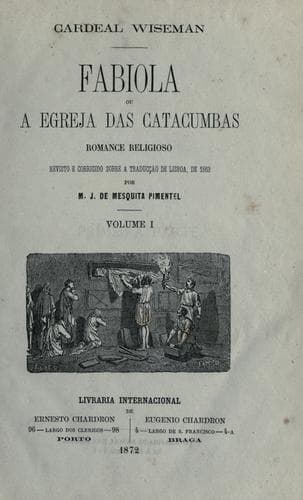
Fabiola; Or, The Church of the CatacombsWiseman, Nicholas Patrick
HistoryHistory
Fabiola; Or, The Church of the Catacombs
Wiseman, Nicholas Patrick
Christian fiction; Church history -- Primitive and early church, ca. 30-600 -- Fiction; Historical fiction
CINNAMIVS OPAS LECTOR TITVLI FASCIOLE AMICVS PAVPERVM
QVI VIXIT ANN. XLVI. MENS. VII. D. VIII. DEPOSIT IN PACE
X KAL. MART.[129]
Of an Exorcist:
MACEDONIVS
EXORCISTA DE KATOLICA.[130]
A difference was, however, that one order was not necessarily a passage,
or step, to another; but persons remained, often for life, in one of
these lesser orders. There was not, therefore, that frequent
administration of these, nor probably was it publicly performed with the
higher orders.
Torquatus, having the necessary pass-word, entered, accompanied by
Fulvius, who soon showed himself expert in acting as others did around
him. The assembly was not large. It was held in a hall of the house,
converted into a church or oratory, which was mainly occupied by the
clergy, and the candidates for orders. Among the latter were Marcus and
Marcellianus, the twin brothers, fellow-converts of Torquatus, who
received the deaconship, and their father Tranquillinus, who was
ordained priest. Of these Fulvius impressed well in his mind the
features and figure; and still more did he take note of the clergy, the
most eminent of Rome, there assembled. But on one, more than the rest,
he fixed his piercing eye, studying his every gesture, look, voice, and
lineament.
This was the Pontiff who performed the august rite. Marcellinus had
already governed the Church six years, and was of a venerable old age.
His countenance, benign and mild, scarcely seemed to betoken the
possession of that nerve which martyrdom required, and which he
exhibited in his death for Christ. In those days every outward
characteristic which could have betrayed the chief shepherd to the
wolves was carefully avoided. The ordinary simple garb of respectable
men was worn. But there is no doubt that when officiating at the altar,
a distinctive robe, the forerunner of the ample chasuble, of spotless
white, was cast over the ordinary garment. To this the bishop added a
crown, or _infula_, the origin of the later mitre; while in his hand he
held the crosier, emblem of his pastoral office and authority.
On him who now stood facing the assembly, before the sacred altar of
Peter, which was between him and the
[Illustration: Our Saviour represented as the Good Shepherd, with a
Milk-can at his side, as found in the Catacombs.]
people,[131] the Eastern spy steadied his keenest glance. He scanned him
minutely, measured, with his eye, his height, defined the color of his
hair and complexion, observed every turn of his head, his walk, his
action, his tones, almost his breathing, till he said to himself: “If he
stirs abroad, disguised as he may choose, that man is my prize. And I
know his worth.”
CHAPTER XI.
THE VIRGINS.
PRIE IVN PAVSA
BET PRAETIOSA
ANNORVM PVLLA
VIRGO XII TANTVM
ANCILLA DEI ET [=XPI]
FL. VINCENTIO ET
FRAVITO. [=VC] · CONSS.[132]
Public-domain text, read in full here on John Shaqi.
Reviews
Reviews
No reviews yet
Be the first to share your thoughts on this work.
Elsewhere in the archive
Join the Discussion
Join the discussion
Sign in to leave a comment or review.
Sign InorCreate an account