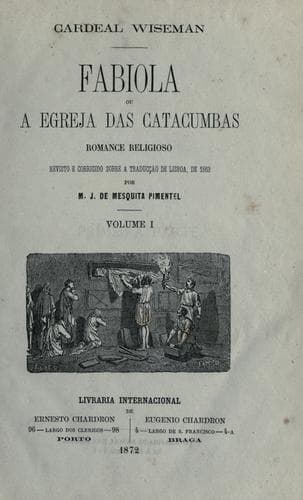
Fabiola; Or, The Church of the CatacombsWiseman, Nicholas Patrick
HistoryHistory
Fabiola; Or, The Church of the Catacombs
Wiseman, Nicholas Patrick
Christian fiction; Church history -- Primitive and early church, ca. 30-600 -- Fiction; Historical fiction
If the learned Thomassinus had known this lately-discovered inscription,
when he proved with such abundance of learning, that virginity could be
professed in the early Church, at the age of twelve, he would certainly
have quoted it.[133] For can we doubt that “the girl who was a virgin of
_only_ twelve years old, a handmaid of God and Christ,” was such by
consecration to God? Otherwise, the more tender her age, the less
wonderful her state of maidenhood.
But although this, the nubile age, according to Roman law, was the one
at which such dedication to God was permitted by the Church, she
reserved to a maturer period that more solemn consecration, when the
veil of virginity was given by the bishop; generally on Easter Sunday.
That first act probably consisted of nothing more than receiving from
the hands of parents a plain dark dress. But when any danger threatened,
the Church permitted the anticipation, by many years, of that period,
and fortified the spouses of Christ in their holy purpose, by her more
solemn blessing.[134]
A persecution of the most savage character was on the point of breaking
out, which would not spare the most tender of the flock; and it was no
wonder that they, who in their hearts had betrothed themselves to the
Lamb, as His chaste spouses forever, should desire to come to His
nuptials before death. They longed naturally to bear the full-grown
lily, entwined round the palm, should this be their portion.
Agnes had from her infancy chosen for herself this holiest state. The
superhuman wisdom which had ever exhibited itself in her words and
actions, blending so gracefully with the simplicity of an innocent and
guileless childhood, rendered her ripe, beyond her years, for any
measure of indulgence which could be granted, to hearts that panted for
their chaste bridal-hour. She eagerly seized on the claim that coming
danger gave her, to a more than usual relaxation of that law which
prescribed a delay of more than ten years in the fulfilling of her
desire. Another postulant joined her in this petition.
We may easily imagine that a holy friendship had been growing between
her and Syra, from the first interview which we have described between
them. This feeling had been increased by all that Agnes had heard
Fabiola say, in praise of her favorite servant. From this, and from the
slave’s more modest reports, she was satisfied that the work to which
she had devoted herself, of her mistress’s conversion, must be entirely
left in her hands. It was evidently prospering, owing to the prudence
and grace with which it was conducted. In her frequent visits to
Fabiola, she contented herself with admiring and approving what her
cousin related of Syra’s conversations; but she carefully avoided every
expression that could raise suspicion of any collusion between them.
Public-domain text, read in full here on John Shaqi.
Reviews
Reviews
No reviews yet
Be the first to share your thoughts on this work.
Elsewhere in the archive
Join the Discussion
Join the discussion
Sign in to leave a comment or review.
Sign InorCreate an account