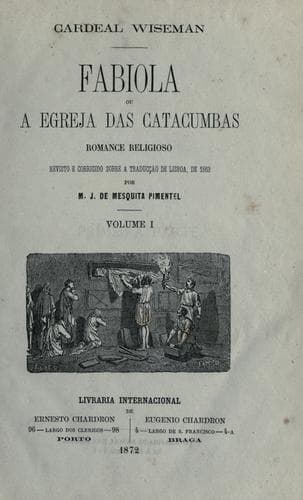
Fabiola; Or, The Church of the CatacombsWiseman, Nicholas Patrick
HistoryHistory
Fabiola; Or, The Church of the Catacombs
Wiseman, Nicholas Patrick
Christian fiction; Church history -- Primitive and early church, ca. 30-600 -- Fiction; Historical fiction
Syra as a dependant, and Agnes as a relation, had put on mourning upon
Fabius’s death; and hence no change of habit would raise suspicion in
his daughter’s mind, of their having taken some secret, or some joint
step. Thus far they could safely ask to be admitted at once to receive
the solemn consecration to perpetual virginity. Their petition was
granted; but for obvious reasons was kept carefully concealed. It was
only a day or two before the happy one of their spiritual nuptials, that
Syra told it, as a great secret, to her blind friend.
“And so,” said the latter, pretending to be displeased, “you want to
keep all the good things to yourself. Do you call that charitable, now?”
“My dear child,” said Syra, soothingly, “don’t be offended. It was
necessary to keep it quite a secret.”
“And therefore, I suppose, poor I must not even be present?”
“Oh, yes, Cæcilia, to be sure you may; and see all that you can,”
replied Syra, laughing.
“Never mind about the seeing. But tell me, how will you be dressed? What
have you to get ready?”
Syra gave her an exact description of the habit and veil, their color
and form.
“How very interesting!” she said. “And what have you to do?”
The other, amused at her unwonted curiosity, described minutely the
short ceremonial.
“Well now, one question more,” resumed the blind girl. “When and where
is all this to be? You said I might come, so I must know the time and
place.”
Syra told her it would be at the _title_ of Pastor, at daybreak, on the
third day from that. “But what has made you so inquisitive, dearest? I
never saw you so before. I am afraid you are becoming quite worldly.”
“Never you mind,” replied Cæcilia, “if people choose to have secrets
from me, I do not see why I should not have some of my own.”
Syra laughed at her affected pettishness, for she knew well the humble
simplicity of the poor child’s heart. They embraced affectionately and
parted. Cæcilia went straight to the kind Lucina, for she was a favorite
in every house. No sooner was she admitted to that pious matron’s
presence, than she flew to her, threw herself upon her bosom, and burst
into tears. Lucina soothed and caressed her, and soon composed her. In a
few minutes she was again bright and joyous, and evidently deep in
conspiracy, with the cheerful lady, about something which delighted her.
When she left she was all buoyant and blithe, and went to the house of
Agnes, in the hospital of which the good priest Dyonisius lived. She
found him at home; and casting herself on her knees before him, talked
so fervently to him that he was moved to tears, and spoke kindly and
consolingly to her. The _Te Deum_ had not yet been written; but
something very like it rang in the blind girl’s heart, as she went to
her humble home.
Public-domain text, read in full here on John Shaqi.
Reviews
Reviews
No reviews yet
Be the first to share your thoughts on this work.
Elsewhere in the archive
Join the Discussion
Join the discussion
Sign in to leave a comment or review.
Sign InorCreate an account