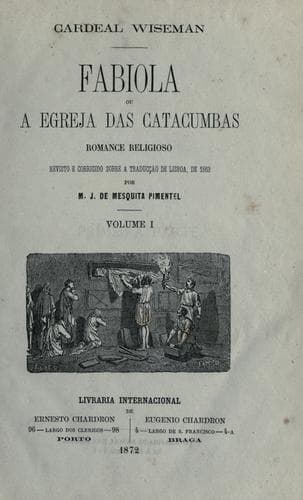
Fabiola; Or, The Church of the CatacombsWiseman, Nicholas Patrick
HistoryHistory
Fabiola; Or, The Church of the Catacombs
Wiseman, Nicholas Patrick
Christian fiction; Church history -- Primitive and early church, ca. 30-600 -- Fiction; Historical fiction
In the centre of the marble pavement a softly warbling jet of pure
water, brought by the Claudian aqueduct from the Tusculan hills, springs
into the air, now higher, now lower, and falls into an elevated basin of
red marble, over the sides of which it flows in downy waves; and before
reaching its lower and wider recipient, scatters a gentle shower on the
rare and brilliant flowers placed in elegant vases around. Under the
portico we see furniture disposed, of a rich and sometimes rare
character; couches inlaid with ivory, and even silver; tables of
oriental woods, bearing candelabra, lamps, and other household
implements of bronze or silver; delicately chased busts, vases, tripods,
and objects of mere art. On the walls are paintings evidently of a
former period, still, however, retaining all their brightness of color
and freshness of execution. These are separated by niches with statues,
representing indeed, like the pictures, mythological or historical
subjects; but we cannot help observing that nothing meets the eye which
could offend the most delicate mind. Here and there an empty niche, or a
covered painting, proves that this is not the result of accident.
[Illustration: _Atrium_ of a Pompeian house.]
[Illustration: _Atrium_ of a house in Pompeii.]
As outside the columns, the coving roof leaves a large square opening in
its centre, called the _impluvium_, there is drawn across it a curtain,
or veil of dark canvas, which keeps out the sun and rain. An artificial
twilight therefore alone enables us to see all that we have described;
but it gives greater effect to what is beyond. Through an arch,
opposite to the one whereby we have entered, we catch a glimpse of an
inner and still richer court, paved with variegated marbles, and adorned
with bright gilding. The veil of the opening above, which, however, here
is closed with thick glass or talc (_lapis specularis_), has been partly
withdrawn, and admits a bright but softened ray from the evening sun on
to the place, where we see, for the first time, that we are in no
enchanted hall, but in an inhabited house.
Public-domain text, read in full here on John Shaqi.
Reviews
Reviews
No reviews yet
Be the first to share your thoughts on this work.
Join the Discussion
Join the discussion
Sign in to leave a comment or review.
Sign InorCreate an account