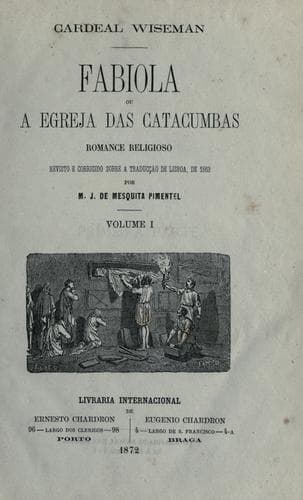
Fabiola; Or, The Church of the CatacombsWiseman, Nicholas Patrick
HistoryHistory
Fabiola; Or, The Church of the Catacombs
Wiseman, Nicholas Patrick
Christian fiction; Church history -- Primitive and early church, ca. 30-600 -- Fiction; Historical fiction
We have thus the exact arrangements to be found in the churches built
after the peace, and yet to be seen in all the ancient basilicas in
Rome--the episcopal chair in the centre of the apse, the presbytery or
seat for the clergy on either hand, and the altar between the throne and
the people. The early Christians thus anticipated underground, or rather
gave the principles which directed, the forms of ecclesiastical
architecture.
It was in such a basilica, then, that we are to imagine the faithful
assembled, when Corvinus and his satellites arrived at the entrance of
the cemetery. This was the way which Torquatus knew, leading down by
steps from a half-ruinous building, choked up with faggots. They found
the coast clear, and immediately made their arrangements. Fulvius, with
one body of ten or twelve men, lurked to guard the entrance, and seize
all who attempted to come out or go in. Corvinus, with Torquatus and a
smaller body of eight, prepared to descend.
“I don’t like this underground work,” said an old, grey-bearded
legionary. “I am a soldier, and not a rat-catcher. Bring me my man into
the light of day, and I will fight him hand to hand, and foot to foot;
but I have no love for being stifled or poisoned, like vermin in a
drain.”
This speech found favor with the soldiers. One said, “There may be
hundreds of these skulking Christians down there, and we are little more
than half a dozen.”
“This is not the sort of work we receive our pay for,” added another.
“It’s their sorceries I care for,” continued a third, “and not their
valor.”
It required all the eloquence of Fulvius to screw up their resolution.
He assured them there was nothing to fear; that the cowardly Christians
would run before them like hares, and that they would find more gold and
silver in the church than a year’s pay would give them. Thus encouraged,
they went groping down to the bottom of the stairs. They could
distinguish lamps at intervals, stretching into the gloomy length before
them.
“Hush!” said one, “listen to that voice!”
[Illustration: An Altar with its Episcopal Chair, in the Cemetery of
Saint Agnes.]
From far away its accents came, softened by distance, but they were the
notes of a fresh youthful voice, that quailed not with fear; so clear,
that the very words could be caught, as it intoned the following verses:
“Dominus illuminatio mea, et salus mea; quem timebo?
[Illustration: An Attack in the Catacombs.]
“Dominus protector vitæ meæ; a quo trepidabo?”[149]
Then came a full chorus of voices, singing, like the sound of many
waters:
“Dum appropriant super me nocentes, ut edant carnes meas; qui tribulant
me, inimici mei, ipsi infirmati sunt et ceciderunt.”[150]
A mixture of shame and anger seized on the assailants as they heard
these words of calm confidence and defiance. The single voice again sang
forth, but in apparently fainter accents:
“Si consistant adversum me castra, non timebit cor meum.”[151]
Public-domain text, read in full here on John Shaqi.
Reviews
Reviews
No reviews yet
Be the first to share your thoughts on this work.
Elsewhere in the archive
Join the Discussion
Join the discussion
Sign in to leave a comment or review.
Sign InorCreate an account