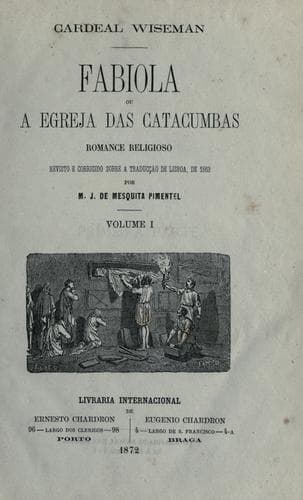
Fabiola; Or, The Church of the CatacombsWiseman, Nicholas Patrick
HistoryHistory
Fabiola; Or, The Church of the Catacombs
Wiseman, Nicholas Patrick
Christian fiction; Church history -- Primitive and early church, ca. 30-600 -- Fiction; Historical fiction
“I thought I knew that voice,” muttered Corvinus. “I ought to know it
out of a thousand. It is that of my bane, the cause of all last night’s
curse and this day’s trouble. It is that of Pancratius, who pulled down
the edict. On, on, my men; any reward for him, dead or alive!”
“But, stop,” said one, “let us light our torches.”
“Hark!” said a second, while they were engaged in this operation; “what
is that strange noise, as if of scratching and hammering at a distance?
I have heard it for some time.”
“And, look!” added a third; “the distant lights have disappeared, and
the music has ceased. We are certainly discovered.”
“No danger,” said Torquatus, putting on a boldness which he did not
feel. “That noise only comes from those old moles, Diogenes and his
sons, busy preparing graves for the Christians we shall seize.”
[Illustration: An Altar in the Cemetery of St. Sixtus.]
Torquatus had in vain advised the troop not to bring torches, but to
provide themselves with such lamps as we see Diogenes represented
carrying, in his picture, or waxen tapers, which he had brought for
himself; but the men swore they would not go down without plenty of
light, and such means for it as could not be put out by a draught of
wind, or a stroke on the arm. The effects were soon obvious. As they
advanced, silently and cautiously, along the low narrow gallery, the
resinous torches crackled and hissed with a fierce glare, which heated
and annoyed them; while a volume of thick pitchy smoke from each rolled
downwards on to the bearers from the roof, half stifled them, and made a
dense atmosphere of cloud around themselves, which effectually dimmed
their light. Torquatus kept at the head of the party, counting every
turning right and left, as he had noted them; though he found every
mark which he had made carefully removed. He was staggered and baulked,
when, after having counted little more than half the proper number, he
found the road completely blocked up.
The fact was, that keener eyes than he was aware of had been on the
look-out. Severus had never relaxed his watchfulness, determined not to
be surprised. He was near the entrance to the cemetery below, when the
soldiers reached it above; and he ran forward at once to the place where
the sand had been prepared for closing the road; near which his brother
and several other stout workmen were stationed, in case of danger. In a
moment, with that silence and rapidity to which they were trained, they
set to work lustily, shovelling the sand across the narrow and low
corridor from each side, while well-directed blows of the pick brought
from the low roof behind, huge flakes of sandstone, which closed up the
opening. Behind this barrier they stood, hardly suppressing a laugh as
they heard their enemies through its loose separation. Their work it was
which had been heard, and which had screened off the lights, and
deadened the song.
Public-domain text, read in full here on John Shaqi.
Reviews
Reviews
No reviews yet
Be the first to share your thoughts on this work.
Elsewhere in the archive
Join the Discussion
Join the discussion
Sign in to leave a comment or review.
Sign InorCreate an account