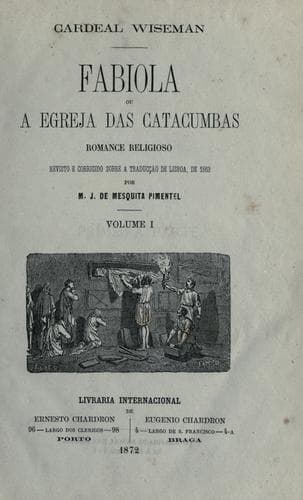
Fabiola; Or, The Church of the CatacombsWiseman, Nicholas Patrick
HistoryHistory
Fabiola; Or, The Church of the Catacombs
Wiseman, Nicholas Patrick
Christian fiction; Church history -- Primitive and early church, ca. 30-600 -- Fiction; Historical fiction
Torquatus’s perplexity was not diminished by the volley of oaths and
imprecations, and the threats of violence which were showered upon him,
for a fool or a traitor. “Stay one moment, I entreat you,” he said. “It
is possible I have mistaken my reckoning. I know the right turn by a
remarkable tomb a few yards within it; I will just step into one or two
of the last corridors, and see.”
With these words, he ran back to the next gallery on the left, advanced
a few paces, and totally disappeared.
Though his companions had followed him to the very mouth of the gallery,
they could not see how this happened. It appeared like witchcraft, in
which they were quite ready to believe. His light and himself seemed to
have vanished at once. “We will have no more of this work,” they said;
“either Torquatus is a traitor, or he has been carried off by magic.”
Worried, heated in the close atmosphere, almost inflamed by their
lights, begrimed, blinded, and choked by the pitchy smoke, crest-fallen
and disheartened, they turned back; and since their road led straight to
the entrance, they flung away their blazing torches into the side
galleries, one here and one there, as they passed by, to get rid of
them. When they looked back, it seemed as if a triumphal illumination
was kindling up the very atmosphere of the gloomy corridor. From the
mouths of the various caverns came forth a fiery light which turned the
dull sandstone into a bright crimson; while the volumes of smoke above,
hung like amber clouds along the whole gallery. The sealed tombs,
receiving the unusual reflection on their yellow tiles, or marble slabs,
appeared covered with golden or silver plates, set in the red damask of
the walls. It looked like a homage paid to martyrdom, by the very furies
of heathenism, on the first day of persecution. The torches which they
had kindled to destroy, only served to shed brightness on monuments of
that virtue which had never failed to save the Church.
But before these foiled hounds with drooping heads had reached the
entrance, they recoiled before the sight of a singular apparition. At
first they thought they had caught a glimpse of daylight; but they soon
perceived it was the glimmering of a lamp. This was held steadily by an
upright, immovable figure, which thus received its light upon itself. It
was clothed in a dark dress, so as to resemble one of those bronze
statues, which have the head and extremities of white marble, and
startle one, when first seen; so like are they to living forms.
“Who can it be? What is it?” the men whispered to one another.
“A sorceress,” replied one.
“The _genius loci_,”[152] observed another.
“A spirit,” suggested a third.
Still, as they approached stealthily towards it, it did not appear
conscious of their presence: “there was no speculation in its eyes;” it
remained unmoved and unscared. At length, two got sufficiently near to
seize the figure by its arms.
“Who are you?” asked Corvinus, in a rage.
Public-domain text, read in full here on John Shaqi.
Reviews
Reviews
No reviews yet
Be the first to share your thoughts on this work.
Elsewhere in the archive
Join the Discussion
Join the discussion
Sign in to leave a comment or review.
Sign InorCreate an account