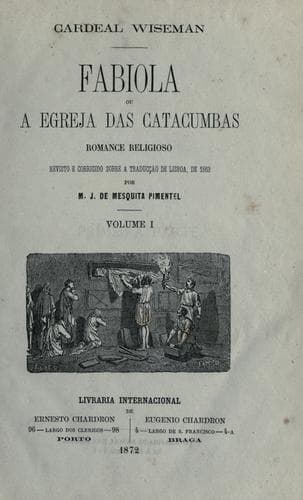
Fabiola; Or, The Church of the CatacombsWiseman, Nicholas Patrick
HistoryHistory
Fabiola; Or, The Church of the Catacombs
Wiseman, Nicholas Patrick
Christian fiction; Church history -- Primitive and early church, ca. 30-600 -- Fiction; Historical fiction
“A Christian,” answered Cæcilia, with her usual cheerful gentleness.
[Illustration: The Cure of the Man born Blind, from a picture in the
Catacombs.]
“Bring her along,” he commanded; “some one at least shall pay for our
disappointment.”
CHAPTER XVII.
THE FIRST FLOWER.
Cæcilia, already forewarned, had approached the cemetery by a different,
but neighboring entrance. No sooner had she descended than she snuffed
the strong odor of the torches. “This is none of _our_ incense, I know,”
she said to herself; “the enemy is already within.” She hastened
therefore to the place of assembly and delivered Sebastian’s note;
adding also what she had observed. It warned them to disperse and seek
the shelter of the inner and lower galleries; and begged of the Pontiff
not to leave till he should send for him, as his person was particularly
sought for.
Pancratius urged the blind messenger to save herself too. “No,” she
replied, “my office is to watch the door, and guide the faithful safe.”
“But the enemy may seize you.”
“No matter,” she answered, laughing; “my being taken may save much
worthier lives. Give me a lamp, Pancratius.”
“Why, you cannot see by it,” observed he, smiling.
“True, but others can.”
“They may be your enemies.”
“Even so,” she answered, “I do not wish to be taken in the dark. If my
Bridegroom come to me in the night of this cemetery, must He not find
me with my lamp trimmed?”
Off she started, reached her post, and hearing no noise except that of
quiet footsteps, she thought they were those of friends, and held up her
lamp to guide them.
When the party came forth, with their only captive, Fulvius was
perfectly furious. It was worse than a total failure: it was
ridiculous--a poor mouse come out of the bowels of the earth. He rallied
Corvinus till the wretch winced and foamed; then suddenly he asked, “And
where is Torquatus?” He heard the account of his sudden disappearance,
told in as many ways as the Dacian guard’s adventure: but it annoyed him
greatly. He had no doubt whatever, in his own mind, that he had been
duped by his supposed victim, who had escaped into the unsearchable
mazes of the cemetery. If so, this captive would know, and he determined
to question her. He stood before her, therefore, put on his most
searching and awful look, and said to her sternly, “Look at me, woman,
and tell me the truth.”
“I must tell you the truth without looking at you, sir,” answered the
poor girl, with her cheerfullest smile and softest voice; “do you not
see that I am blind?”
“Blind!” all exclaimed at once, as they crowded to look at her. But over
the features of Fulvius there passed the slightest possible emotion,
just as much as the wave that runs, pursued by a playful breeze, over
the ripe meadow. A knowledge had flashed into his mind, a clue had
fallen into his hand.
Public-domain text, read in full here on John Shaqi.
Reviews
Reviews
No reviews yet
Be the first to share your thoughts on this work.
Elsewhere in the archive
Join the Discussion
Join the discussion
Sign in to leave a comment or review.
Sign InorCreate an account