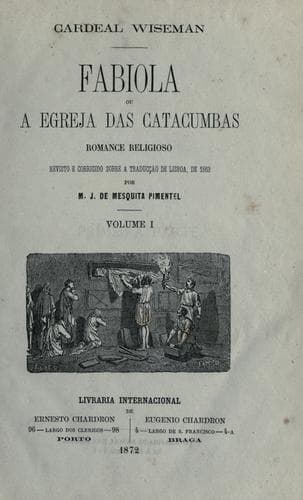
Fabiola; Or, The Church of the CatacombsWiseman, Nicholas Patrick
HistoryHistory
Fabiola; Or, The Church of the Catacombs
Wiseman, Nicholas Patrick
Christian fiction; Church history -- Primitive and early church, ca. 30-600 -- Fiction; Historical fiction
“It will be ridiculous,” he said, “for twenty soldiers to march through
the city, guarding a blind girl. Return to your quarters, and I will see
you are well rewarded. You, Corvinus, take my horse, and go before to
your father, and tell him all, I will follow in a carriage with the
captive.”
“No treachery, Fulvius,” he said, vexed and mortified. “Mind you bring
her. The day must not pass without a sacrifice.”
“Do not fear,” was the reply.
Fulvius, indeed, was pondering whether, having lost one spy, he should
not try to make another. But the placid gentleness of the poor beggar
perplexed him more than the boisterous zeal of the gamester, and her
sightless orbs defied him more than the restless roll of the toper’s.
Still, the first thought that had struck him he could yet pursue. When
alone in a carriage with her, he assumed a soothing tone, and addressed
her. He knew she had not overheard the last dialogue.
“My poor girl,” he said, “how long have you been blind?”
“All my life,” she replied.
“What is your history? Whence do you come?”
“I have no history. My parents were poor, and brought me to Rome when I
was four years old, as they came to pray, in discharge of a vow made for
my life in early sickness, to the blessed martyrs Chrysanthus and Daria.
They left me in charge of a pious lame woman, at the door of the title
of Fasciola, while they went to their devotions. It was on that
memorable day, when many Christians were buried at their tomb, by earth
and stones cast down upon them. My parents had the happiness to be of
the number.”
“And how have you lived since?”
“God became my only Father then, and His Catholic Church my mother. The
one feeds the birds of the air, the other nurses the weaklings of the
flock. I have never wanted for any thing since.”
“But you can walk about the streets freely, and without fear, as well as
if you saw.”
“How do you know that?”
“I have seen you. Do you remember very early one morning in the autumn,
leading a poor lame man along the Vicus Patricius?”
She blushed and remained silent. Could he have seen her put into the
poor old man’s purse her own share of the alms?
“You have owned yourself a Christian?” he asked negligently.
“Oh, yes! how could I deny it?”
“Then that meeting was a Christian meeting?”
“Certainly; what else could it be?”
He wanted no more; his suspicions were verified. Agnes, about whom
Torquatus had been able or willing to tell him nothing, was certainly a
Christian. His game was made. She must yield, or he would be avenged.
After a pause, looking at her steadfastly, he said, “Do you know whither
you are going?”
“Before the judge of earth, I suppose, who will send me to my Spouse in
heaven.”
“And so calmly?” he asked in surprise; for he could see no token from
the soul to the countenance, but a smile.
“So joyfully rather,” was her brief reply.
Public-domain text, read in full here on John Shaqi.
Reviews
Reviews
No reviews yet
Be the first to share your thoughts on this work.
Elsewhere in the archive
Join the Discussion
Join the discussion
Sign in to leave a comment or review.
Sign InorCreate an account