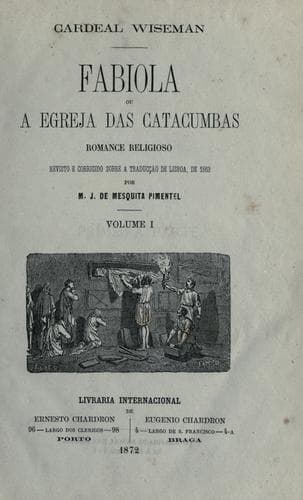
Fabiola; Or, The Church of the CatacombsWiseman, Nicholas Patrick
HistoryHistory
Fabiola; Or, The Church of the Catacombs
Wiseman, Nicholas Patrick
Christian fiction; Church history -- Primitive and early church, ca. 30-600 -- Fiction; Historical fiction
“I am, indeed, a slave of Cæsar’s,” answered the prisoner; “but becoming
a Christian, I have been freed by Christ Himself; and by His grace and
mercy I have been made partaker of the same hope as those whom you see.”
Then turning to a holy priest, Lucianus, venerable for his years and his
virtues, the judge thus addressed him: “Come, be obedient to the gods
themselves, and to the imperial edicts.”
“No one,” answered the old man, “can be reprehended or condemned who
obeys the precepts of Jesus Christ our Saviour.”
“What sort of learning and studies dost thou pursue?”
“I have endeavored to master every science, and have tried every variety
of learning. But finally I adhered to the doctrines of Christianity,
although they do not please those who follow the wanderings of false
opinions.”
“Wretch! dost thou find delight in _that_ learning?”
“The greatest; because I follow the Christians in right doctrine.”
“And what is that doctrine?”
“The right doctrine, which we Christians piously hold, is to believe in
one God, the Maker and Creator of all things visible and invisible; and
to confess the Lord Jesus Christ the Son of God, anciently foretold by
the prophets, who will come to judge mankind, and is the preacher and
master of salvation, to those who will learn well under Him. I indeed,
as a mere man, am too weak and insignificant to be able to utter any
thing great of _His infinite Deity_: this office belongs to the
prophets.”[166]
“Thou art, methinks, a master of error to others, and deservest to be
more severely punished than the rest. Let this Lucianus be kept in the
nerve (stocks) with his feet stretched to the fifth hole.[167]--And you
two women, what are your names and condition?”
“I am a Christian, who have no spouse but Christ. My name is Secunda,”
replied the one.
“And I am a widow, named Rufina, professing the same saving faith,”
continued the other.
At length, after having put similar questions, and receiving similar
answers from all the others, except from one wretched man, who, to the
grief of the rest, wavered and agreed to offer sacrifice, the prefect
turned to Pancratius, and thus addressed him: “And now, insolent youth,
who hadst the audacity to tear down the edict of the divine emperors,
even for thee there shall be mercy, if yet thou wilt sacrifice to the
gods. Show thus at once thy piety and thy wisdom, for thou art yet but a
stripling.”
Pancratius signed himself with the sign of the saving cross, and calmly
replied, “I am the servant of Christ. Him I acknowledge by my mouth,
hold firm in my heart, _incessantly adore_. This youth which you behold
in me has the wisdom of grey hairs if it worship but one God. But your
gods, with those who adore them, are destined to eternal
destruction.”[168]
“Strike him on the mouth for his blasphemy, and beat him with rods,”
exclaimed the angry judge.
“I thank thee,” replied meekly the noble youth, “that thus I suffer some
of the same punishment as was inflicted on my Lord.”[169]
Public-domain text, read in full here on John Shaqi.
Reviews
Reviews
No reviews yet
Be the first to share your thoughts on this work.
Elsewhere in the archive
Join the Discussion
Join the discussion
Sign in to leave a comment or review.
Sign InorCreate an account