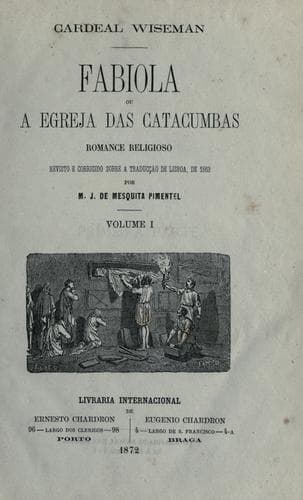
Fabiola; Or, The Church of the CatacombsWiseman, Nicholas Patrick
HistoryHistory
Fabiola; Or, The Church of the Catacombs
Wiseman, Nicholas Patrick
Christian fiction; Church history -- Primitive and early church, ca. 30-600 -- Fiction; Historical fiction
The prefect then pronounced sentence in the usual form. “Lucianus,
Pancratius, Rusticus, and others, and the women Secunda and Rufina, who
have all owned themselves Christians, and refuse to obey the sacred
emperor, or worship the gods of Rome, we order to be exposed to wild
beasts, in the Flavian amphitheatre.”
[Illustration: The Blessed Virgin, from a portrait found in the Cemetery
of St. Agnes.]
The mob howled with delight and hatred, and accompanied the confessors
back to their prison with this rough music; but they were gradually
overawed by the dignity of their gait, and the shining calmness of their
countenances. Some men asserted that they must have perfumed themselves,
for they could perceive a fragrant atmosphere surrounding their
persons.[170]
CHAPTER XXII.
THE VIATICUM.
A true contrast to the fury and discord without, was the scene within
the prison. Peace, serenity, cheerfulness, and joy reigned there; and
the rough stone walls and vaults re-echoed to the chant of psalmody, in
which Pancratius was precentor, and in which depth called out to depth;
for the prisoners in the lower dungeon responded to those above, and
kept up the alternation of verses, in those psalms which the
circumstances naturally suggested.
The eve of “fighting with,” that is being torn to pieces by, wild
beasts, was always a day of greater liberty. The friends of the intended
victims were admitted to see them; and the Christians boldly took full
advantage of the permission to flock to the prison, and commend
themselves to the prayers of the blessed confessors of Christ. At
evening they were led forth to enjoy what was called the free supper,
that is, an abundant, and even luxurious, public feast. The table was
surrounded by pagans, curious to watch the conduct and looks of the
morrow’s combatants. But they could discern neither the bravado and
boisterousness, nor the dejection and bitterness of ordinary culprits.
To the guests it was truly an _agape_, or love-feast; for they supped
with calm joyfulness amidst cheerful conversation. Pancratius, however,
once or twice reproved the unfeeling curiosity, and rude remarks of the
crowd, saying, “To-morrow is not sufficient for you, because you love to
look upon the objects of your future hatred. To-day you are our friends;
to-morrow our foes. But mark well our countenances, that you may know
them again in the day of judgment.” Many retired at this rebuke, and not
a few were led by it to conversion.[171]
Public-domain text, read in full here on John Shaqi.
Reviews
Reviews
No reviews yet
Be the first to share your thoughts on this work.
Elsewhere in the archive
Join the Discussion
Join the discussion
Sign in to leave a comment or review.
Sign InorCreate an account