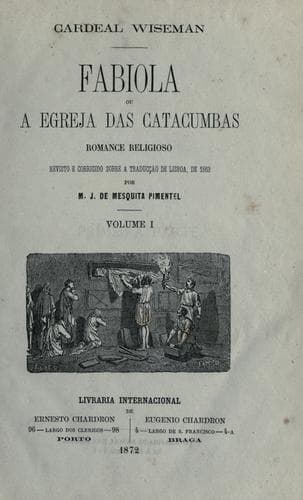
Fabiola; Or, The Church of the CatacombsWiseman, Nicholas Patrick
HistoryHistory
Fabiola; Or, The Church of the Catacombs
Wiseman, Nicholas Patrick
Christian fiction; Church history -- Primitive and early church, ca. 30-600 -- Fiction; Historical fiction
But while the persecutors thus prepared a feast for the bodies of their
victims, the Church, their mother, had been preparing a much more dainty
banquet for the souls of her children. They had been constantly attended
on by the deacons, particularly Reparatus, who would gladly have joined
their company. But his duty forbade this at present. After, therefore,
having provided as well as possible for their temporal wants, he had
arranged with the pious priest Dionysius, who still dwelt in the house
of Agnes, to send, towards evening, sufficient portions of the Bread of
Life, to feed, early in the morning of their battle, the champions of
Christ. Although the deacons bore the consecrated elements from the
principal church to others, where they were only distributed by the
titulars, the office of conveying them to the martyrs in prison, and
even to the dying, was committed to inferior ministers. On this day,
that the hostile passions of heathen Rome were unusually excited by the
coming slaughter of so many Christian victims, it was a work of more
than common danger to discharge this duty. For the revelations of
Torquatus had made it known that Fulvius had carefully noted all the
ministers of the sanctuary, and given a description of them to his
numerous active spies. Hence they could scarcely venture out by day,
unless thoroughly disguised.
The sacred Bread was prepared, and the priest turned round from the
altar on which it was placed, to see who would be its safest bearer.
Before any other could step forward, the young acolyte Tarcisius knelt
at his feet. With his hands extended before him, ready to receive the
sacred deposit, with a countenance beautiful in its lovely innocence as
an angel’s, he seemed to entreat for preference, and even to claim it.
“Thou art too young, my child,” said the kind priest, filled with
admiration of the picture before him.
“My youth, holy father, will be my best protection. Oh! do not refuse me
this great honor.” The tears stood in the boy’s eyes, and his cheeks
glowed with a modest emotion as he spoke these words. He stretched forth
his hands eagerly, and his entreaty was so full of fervor and courage
that the plea was irresistible. The priest took the Divine Mysteries
wrapped up carefully in a linen cloth, then in an outer covering, and
put them on his palms, saying:
“Remember, Tarcisius, what a treasure is intrusted to thy feeble care.
Avoid public places as thou goest along; and remember that holy things
must not be delivered to dogs, nor pearls be cast before swine. Thou
wilt keep safely God’s sacred gifts?”
“I will die rather than betray them,” answered the holy youth, as he
folded the heavenly trust in the bosom of his tunic, and with cheerful
reverence started on his journey. There was a gravity beyond the usual
expression of his years stamped upon his countenance, as he tripped
lightly along the streets, avoiding equally the more public, and the too
low, thoroughfares.
Public-domain text, read in full here on John Shaqi.
Reviews
Reviews
No reviews yet
Be the first to share your thoughts on this work.
Elsewhere in the archive
Join the Discussion
Join the discussion
Sign in to leave a comment or review.
Sign InorCreate an account