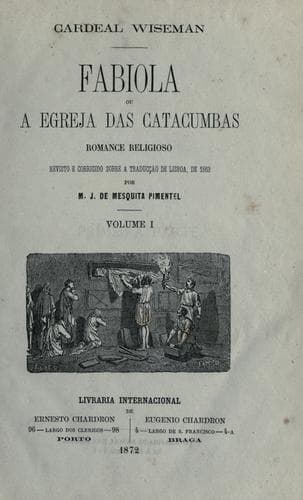
Fabiola; Or, The Church of the CatacombsWiseman, Nicholas Patrick
HistoryHistory
Fabiola; Or, The Church of the Catacombs
Wiseman, Nicholas Patrick
Christian fiction; Church history -- Primitive and early church, ca. 30-600 -- Fiction; Historical fiction
As he was approaching the door of a large mansion, its mistress, a rich
lady without children, saw him coming, and was struck with his beauty
and sweetness, as, with arms folded on his breast, he was hastening on.
“Stay, one moment, dear child,” she said, putting herself in his way:
“tell me thy name, and where do thy parents live?”
“I am Tarcisius, an orphan boy,” he replied, looking up, smilingly;
“and I have no home, save one which it might be displeasing to thee to
hear.”
“Then come into my house and rest; I wish to speak to thee. Oh, that I
had a child like thee!”
“Not now, noble lady, not now. I have intrusted to me a most solemn and
sacred duty, and I must not tarry a moment in its performance.”
“Then promise to come to me to-morrow; this is my house.”
“If I am alive, I will,” answered the boy with a kindled look, which
made him appear to her as a messenger from a higher sphere. She watched
him a long time, and after some deliberation determined to follow him.
Soon, however, she heard a tumult with horrid cries, which made her
pause, on her way, until they had ceased, when she went on again.
In the meantime, Tarcisius, with his thoughts fixed on better things
than her inheritance, hastened on, and shortly came into an open space,
where boys, just escaped from school, were beginning to play.
“We just want one to make up the game; where shall we get him?” said
their leader.
“Capital!” exclaimed another, “here comes Tarcisius, whom I have not
seen for an age. He used to be an excellent hand at all sports. Come,
Tarcisius,” he added, stopping him by seizing his arm, “whither so fast?
take a part in our game, that’s a good fellow.”
“I can’t, Petilius, now; I really can’t. I am going on business of great
importance.”
“But you shall,” exclaimed the first speaker, a strong and bullying
youth, laying hold of him. “I will have no sulking, when I want any
thing done. So come, join us at once.”
“I entreat you,” said the poor boy feelingly, “do let me go.”
“No such thing,” replied the other. “What is that you seem to be
carrying so carefully in your bosom? A letter, I suppose; well, it will
not addle by being for half an hour out of its nest. Give it to me, and
I will put it by safe while we play.” And he snatched at the sacred
deposit in his breast.
“Never, never,” answered the child, looking up towards heaven.
“I _will_ see it,” insisted the other rudely; “I will know what is this
wonderful secret.” And he commenced pulling him roughly about. A crowd
of men from the neighborhood soon got round; and all asked eagerly what
was the matter. They saw a boy, who, with folded arms, seemed endowed
with a supernatural strength, as he resisted every effort of one much
bigger and stronger, to make him reveal what he was bearing. Cuffs,
pulls, blows, kicks seemed to have no effect. He bore them all without a
murmur, or an attempt to retaliate; but he unflinchingly kept his
purpose.
Public-domain text, read in full here on John Shaqi.
Reviews
Reviews
No reviews yet
Be the first to share your thoughts on this work.
Elsewhere in the archive
Join the Discussion
Join the discussion
Sign in to leave a comment or review.
Sign InorCreate an account