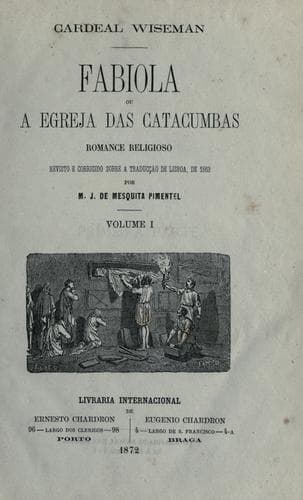
Fabiola; Or, The Church of the CatacombsWiseman, Nicholas Patrick
HistoryHistory
Fabiola; Or, The Church of the Catacombs
Wiseman, Nicholas Patrick
Christian fiction; Church history -- Primitive and early church, ca. 30-600 -- Fiction; Historical fiction
“‘Not so!’ exclaimed Corvinus, ‘not so do you depart, cowardly
worshipper of an ass’s head![9] You have concealed your abode from us,
but I will find you out; till then bear this token of my determined
purpose to be revenged!’ So saying he dealt me a furious blow upon the
face, which made me reel and stagger, while a shout of savage delight
broke forth from the boys around us.”
He burst into tears, which relieved him, and then went on:
“Oh, how I felt my blood boil at that moment! how my heart seemed
bursting within me; and a voice appeared to whisper in my ear scornfully
the name of ‘coward!’ It surely was an evil spirit. I felt that I was
strong enough--my rising anger made me so--to seize my unjust assailant
by the throat, and cast him gasping on the ground. I heard already the
shout of applause that would have hailed my victory and turned the
tables against him. It was the hardest struggle of my life; never were
flesh and blood so strong within me. O God! may they never be again so
tremendously powerful!”
“And what did you do, then, my darling boy?” gasped forth the trembling
matron.
He replied, “My good angel conquered the demon at my side. I thought of
my blessed Lord in the house of Caiphas, surrounded by scoffing enemies,
and struck ignominiously on the cheek, yet meek and forgiving. Could I
wish to be otherwise?[10] I stretched forth my hand to Corvinus, and
said, ‘May God forgive you, as I freely and fully do; and may He bless
you abundantly.’ Cassianus came up at that moment, having seen all from
a distance, and the youthful crowd quickly dispersed. I entreated him,
by our common faith, now acknowledged between us, not to pursue Corvinus
for what he had done; and I obtained his promise. And now, sweet
mother,” murmured the boy, in soft, gentle accents, into his parent’s
bosom, “do you not think I may call this a happy day?”
CHAPTER III.
THE DEDICATION.
While the foregoing conversation was held, the day had fast declined. An
aged female servant now entered unnoticed, and lighted the lamps placed
on marble and bronze candelabra, and quietly retired. A bright light
beamed upon the unconscious group of mother and son, as they remained
silent, after the holy matron Lucina had answered Pancratius’s last
question only by kissing his glowing brow. It was not merely a maternal
emotion that was agitating her bosom; it was not even the happy feeling
of a mother who, having trained her child to certain high and difficult
principles, sees them put to the hardest test, and nobly stand it.
Neither was it the joy of having for her son one, in her estimation, so
heroically virtuous at such an age; for surely, with much greater
justice than the mother of the Gracchi showed her boys to the astonished
matrons of republican Rome as her only jewels, could that Christian
mother have boasted to the Church of the son she had brought up.
Public-domain text, read in full here on John Shaqi.
Reviews
Reviews
No reviews yet
Be the first to share your thoughts on this work.
Join the Discussion
Join the discussion
Sign in to leave a comment or review.
Sign InorCreate an account